



Monday, April 06, 2009
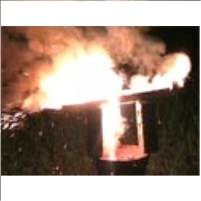 Thermite Melting Steel
A group of scientists has discovered evidence that once again raises the question of what caused the World Trade Center towers to collapse after two jetliners slammed into them on September 11, 2001. The conventional theory that burning jet fuel created intense heat, causing the steel in the towers to weaken, has drawn skeptics, including members of a team that discovered traces of an “active thermitic material” in the dust from the collapsed towers. That material, according to scientists, possesses explosive or incendiary properties, and is most commonly found in steel welding, fireworks shows, and hand grenades.
The scientists, who published their findings in The Open Chemical Physics Journal, do not say how the thermite might have gotten into the World Trade Center dust. Some of the authors of the paper, such as Kevin Ryan, lost their jobs at universities or laboratories for questioning the accepted cause of the towers’ collapse. Ryan wrote a letter to the National Institute of Standards and Technology (NIST), which was investigating the World Trade Center collapse, claiming that the owner of his laboratory subsidiary was the same company that certified the steel components used to build the towers in the early 1970s. The lab, Underwriters Laboratories Ltd., has denied that it tested or certified the components.
The official NIST version says that the towers collapsed because “(1) the impact of the planes severed and damaged support columns, dislodged fireproofing insulation coating the steel floor trusses and steel columns, and widely dispersed jet fuel over multiple floors; and (2) the subsequent unusually large, jet-fuel ignited multi-floor fires weakened the now susceptible structural steel.”
-Noel Brinkerhoff
Scientists Find Active 'Super-thermite' in WTC Dust (by Joe Byrne, Raw Story)
Active Thermitic Material Discovered in Dust from the 9/11 World Trade Center Catastrophe (by Niels H. Harrit, Jeffrey Farrer, Steven E. Jones, Kevin R. Ryan, Frank M. Legge, Daniel Farnsworth, Gregg Roberts, James R. Gourley, and Bradley R. Larsen, Open Chemical Physics Journal)
Area Man Stirs Debate on WTC Collapse (by John Dobberstein, South Bend Tribune)
NIST and the World Trade Center (NIST FAQ)
NIST and the World Trade Center (NIST full report)
Comments