



Located in Eastern Europe, Ukraine was once part of the Russian, then Soviet empire, from the late 18th century until the end of the Cold War. For a brief period toward the end of World War I, Ukraine declared autonomy, which was followed by three years of civil war. The civil war ended with the western part of Ukrainian territory being incorporated into Poland, and the larger, central and eastern regions being incorporated into the Soviet Union in 1922. As Stalin rose to power in Russia, the Soviets began to impose draconian restrictions on Ukraine, creating an artificial famine and starving millions to death. When the Nazis and Soviets invaded Poland in 1939, the western part of Ukraine was incorporated into the Soviet Union. In 1941, the Nazis invaded Ukraine as part of Germany’s larger attack on the USSR. At first, some Ukrainians welcomed the Germans as a liberating force from Communism, but eventually they realized the true brutality of the regime. Hitler killed hundreds of thousands of Ukrainian Jews, ethnic Ukrainians and others. After World War II, the Soviet Union regained control of Ukraine, dominating its politics for the next 40 years.
Lay of the Land: Ukraine is the largest country located wholly in Europe, with an area of 233,000 square miles. Kiev, the capital, has a population of 2.8 million. The terrain is bounded by the Carpathian Mountains in the southwest and by the Black Sea and the Sea of Azov in the south.
Cimmerians, Scythians, Sarmatians, and Goths were the first groups to settle in what is now Ukraine, arriving throughout the first millennium BC. Each group was known to Greek and Roman traders, and each set up trading outposts that eventually became city-states.
The first wave of Ukrainian immigrants came to the US in 1877 as strikebreakers to the industrialized northeast; before World War I, 70% of the 350,000 Ukrainian immigrants lived in Pennsylvania. The inter-war immigrants numbered only 15,000, and assimilated more easily than their predecessors. Another 80,000 came as displaced persons, refugees from war, and the oppressive Soviet regime.
The US worked with Ukraine throughout the 1990s to help it make strides towards greater democracy and a market economy. In 1999, following a period of high inflation and over-reliance on state controls, Ukraine took steps to bring about economic reform.
US officials supported the “Orange Revolution” in Ukraine in late 2004 and early 2005, warning the former regime against trying to impose fraudulent election results, and hailing Yushchenko’s ultimate victory. President Yushchenko visited the United States from April 4-7, 2005, and had meetings with President George W. Bush and Secretary of State Condoleezza Rice. Yushchenko’s address to a joint session of Congress on April 6 was interrupted by several standing ovations.
From 2004 to 2008, US imports from Ukraine included iron and steel mill products (semi-finished), increasing from $536.9 million to $991.8 million; drilling and oil field equipment and platforms, moving up from $44.9 million to $165.8 million; fuel oil, rising from $51.1 million to $143.4 million; and steelmaking and ferroalloying materials, increasing from $106 million to $278.7 million.
Bush Suggested Ukraine Join NATO
Human rights groups asserted that in 2008 soldiers continued to kill other soldiers during violent hazing events. The Kharkiv office of the International Society for Human Rights reported that violent hazing continued to be widespread. According to the military watchdog group Mothers of Killed Soldiers, most deaths are labeled suicide or accident and were not investigated.
Note: The United States recognized Ukraine Dec 26, 1991. Embassy Kiev was established Jan 23, 1992, with Jon Gundersen as Chargé d’Affaires ad interim.
Appointment: May 11, 1992
Presentation of Credentials: Jun 4, 1992
Termination of Mission: Left post Jul 30, 1993
Appointment: Sep 16, 1993
Presentation of Credentials: Oct 21, 1993
Termination of Mission: Left post Jan 6, 1998
Appointment: Nov 10, 1997
Presentation of Credentials:
Termination of Mission: Left post Oct 9, 2000
Appointment: Sept 15, 2000
Presentation of Credentials: Oct 22, 2000
Termination of Mission: Left post May 1, 2003
Appointment: Jul 1, 2003
Presentation of Credentials: Sept 20, 2003
Termination of Mission: Left post, May 26, 2006
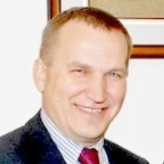 Motsyk, Oleksandr
Oleksandr Motsyk was took over as Ukraine’s Ambassador to the United States on June 11, 2010.
- Table of Contents
- News
- Overview
- Basic Information
- History
- Newspapers
- History of U.S. Relations with Ukraine
- Current U.S. Relations with Ukraine
- Where Does the Money Flow
- Controversies
- Human Rights
- Debate
- Past Ambassadors
- Ambassador to the U.S.
- Embassy Web Site in the U.S.
- Comments
- Leave a comment


U.S. Ambassador to Ukraine
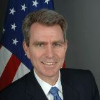
President Barack Obama on February 26 nominated a senior foreign service officer whose 22-year State Department career has focused on Asia and Latin America to be the next ambassador to the eastern European nation of Ukraine. Geoffrey Pyatt will succeed career diplomat John F. Tefft, who served as ambassador to Kyiv starting in November 2009.
Born circa 1963, Geoffrey Ross Pyatt grew up in the wealthy San Diego suburb of La Jolla, California, and earned a B.A. in Political Science at the University of California at Irvine in 1985, and an M.A. in International Relations at Yale in 1987.
Prior to joining the Foreign Service in 1990, Pyatt worked with The Inter-American Dialogue, a Washington-based think tank. At the State Department, Pyatt’s early career assignments included stints as economic officer and vice-consul at the U.S. embassy in Tegucigalpa, Honduras, from 1990-9192; political officer at the embassy in New Delhi, India, from 1992-1994; staff assistant to the assistant secretary of state for Latin America in 1994; special assistant to the deputy secretary of state from 1995 to 1996, and director for Latin America on the National Security Council staff from 1996 to 1997.
Pyatt served as principal officer of the American Consulate in Lahore, Pakistan, from 1997 to 1999, followed by service as American consulate general in Hong Kong, China, from 1999 to 2002. Returning to India, from 2002 to 2007 Pyatt served at the embassy in New Delhi, first as minister counselor for Political Affairs and as deputy chief of mission from June 2006 to July 2007.
When WikiLeaks published State Department cables, Pyatt became embroiled in controversy because of a May 4, 2007, cable he sent recommending that K.V. Rajan, a secretary in the Ministry of External Affairs and a member of the Prime Minister's National Security Advisory Board (NSAB) visit Washington DC in order to help “feed” U.S. government views on Iran into the Indian system.
For his first European posting, Pyatt served as deputy chief of mission at the U.S. Mission to the International Atomic Energy Agency and Other International Organizations in Vienna, Austria, from August 2007 to May 2010, when he was named principal deputy assistant secretary of the South and Central Asia Affairs Bureau.
Pyatt and his wife Mary (née Detchmendy) have two children, William and Claire.
Obama Nominates Candidate for New US Ambassador to Ukraine (by Interfax-Ukraine, Kyiv Post)
morePrevious U.S. Ambassador to Ukraine
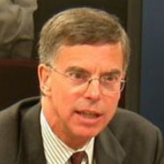
William B. served as the United States Ambassador to Ukraine beginning on May 26, 2006. Taylor graduated from the US Military Academy at West Point and Harvard University’s Kennedy School of Government. As an infantry officer in the US Army, he served in Vietnam and Germany.
more
Comments