



Noted Chinese-Americans
Public Service
Vera Wang: She is a prominent fashion designer, particularly known for her wedding gown collection. She has made wedding gowns for celebrities, such as Maria Carey, Jennifer Lopez, Jessica Simpson, Victoria Beckham, Uma Thurman, Avril Lavigne, Jennifer Garner, Sarah Michelle Gellar, Campbell Brown, and more. After just 6 months in stores, her collection made it to the 3 of the top 10 best-selling patterns in the U.S.
About 2.8 million people of Chinese origin live in the U.S., making them the largest group of Asian Americans. They have settled primarily on the west coast, and in cities such as San Francisco, New York, Boston, Philadelphia, Chicago, Los Angeles, and Seattle. Early Chinese immigrants performed intensive labor in hellish conditions, and faced racially discriminatory immigration laws from 1882-1965. By the turn of the 20th century, nearly 80% of the Chinese population lived in Chinatowns across the country as a means to escape pervasive racism.
The Chinese Communist system is based on repressing free speech, freedom of assembly, freedom of religion and democracy in general. Because of his mixed record during his long climb to the top of the Communist hierarchy, many observers hoped that Hu might introduce reforms relating to civil liberties and political expression. Unfortunately, this has not been the case. To begin with, Hu has made it clear that the Chinese army should be loyal not to the state, but to the Communist Party. In 2004 he reportedly advised Party leaders to study North Korea and Cuba as models for maintaining order.
Title: Commissioner
Appointment: Mar 3, 1843
Note: Commissioned to China. Declined appointment.
Appointment: May 8, 1843
Presentation of Credentials: [about Jun 12, 1844]
Termination of Mission: Left Macao Aug 27, 1844
Note: Commissioned to China. Was issued two separate commissions during a recess of the Senate, one as Commissioner and one as Envoy Extraordinary and Minister Plenipotentiary; after confirmation on Jun 17, 1844, recommissioned as Commissioner only. Presentation of credentials to the Chief of State upon arrival did not become the normal procedure for U.S. diplomatic representatives in China until 1898. The date in brackets represents establishment of an official relationship with appropriate Chinese authorities, not necessarily including communication to them of a letter of credence.
Title: Commissioner
Appointment: Mar 13, 1845
Presentation of Credentials: [Oct 26, 1846]
Termination of Mission: Died at post Jun 28, 1847
Note: Commissioned to China. Presentation of credentials to the Chief of State upon arrival did not become the normal procedure for U.S. diplomatic representatives in China until 1898. The date in brackets represents establishment of an official relationship with appropriate Chinese authorities, not necessarily including communication to them of a letter of credence. Nominated Feb 26, 1845, to be Envoy Extraordinary and Minister Plenipotentiary; the Senate did not confirm this nomination.
Title: Commissioner
Appointment: Jan 3, 1848
Presentation of Credentials: [Oct 6, 1848]
Termination of Mission: Left post May 25, 1850
Note: Commissioned to China. Presentation of credentials to the Chief of State upon arrival did not become the normal procedure for U.S. diplomatic representatives in China until 1898. The date in brackets represents establishment of an official relationship with appropriate Chinese authorities, not necessarily including communication to them of a letter or credence.
Title: Commissioner
Appointment: Oct 15, 1851
Note: Commissioned during a recess of the Senate. Commissioned to China. Declined appointment.
Title: Commissioner
Appointment: Aug 4, 1852
Presentation of Credentials: [Jul 4, 1853]
Termination of Mission: Left post Jan 27, 1854
Note: Commissioned to China. Presentation of credentials to the Chief of State upon arrival did not become the normal procedure for U.S. diplomatic representatives in China until 1898. The date in brackets represents establishment of an official relationship with appropriate Chinese authorities, not necessarily including communication to them of a letter or credence.
Title: Commissioner
Appointment: Jun 21, 1853
Note: Commissioned during recess of the Senate. Commissioned to China. Declined appointment.
Title: Commissioner
Appointment: Oct 18, 1853
Presentation of Credentials: [Nov 3, 1854]
Termination of Mission: Left post Dec 12, 1854
Note: Commissioned during recess of the Senate; recommissioned after confirmation on Dec 6, 1853. Commissioned to China. Presentation of credentials to the Chief of State upon arrival did not become the normal procedure for U.S. diplomatic representatives in China until 1898. The date in brackets represents establishment of an official relationship with appropriate Chinese authorities, not necessarily including communication to them of a letter or credence.
Title: Commissioner
Appointment: Aug 16, 1855
Presentation of Credentials: [Jul 15, 1856]
Termination of Mission: Left China Aug 25, 1857
Note: Commissioned during a recess of Senate; recommissioned after confirmation on May 26, 1856. Commissioned to China. Presentation of credentials to the Chief of State upon arrival did not become the normal procedure for U.S. diplomatic representatives in China until 1898. The date in brackets represents establishment of an official relationship with appropriate Chinese authorities, not necessarily including communication to them of a letter or credence.
Appointment: Apr 18, 1857
Presentation of Credentials: [May 3, 1858]
Termination of Mission: Left China Nov 11, 1858
Note: Commissioned during a recess of the Senate; recommissioned after confirmation on Jan 14, 1858. Commissioned to China. Presentation of credentials to the Chief of State upon arrival did not become the normal procedure for U.S. diplomatic representatives in China until 1898. The date in brackets represents establishment of an official relationship with appropriate Chinese authorities, not necessarily including communication to them of a letter or credence.
Appointment: Dec 15, 1858
Presentation of Credentials: [Aug 10, 1859]
Termination of Mission: Left Hong Kong Dec 15, 1860
Note: Commissioned to China. Presentation of credentials to the Chief of State upon arrival did not become the normal procedure for U.S. diplomatic representatives in China until 1898. The date in brackets represents establishment of an official relationship with appropriate Chinese authorities, not necessarily including communication to them of a letter or credence.
Appointment: Jun 14, 1861
Presentation of Credentials: [Aug 20, 1862]
Termination of Mission: Appointment terminated Nov 21, 1867
Note: Commissioned during a recess of the Senate; recommissioned after confirmation on Jul 15, 1861. Commissioned to China. Presentation of credentials to the Chief of State upon arrival did not become the normal procedure for U.S. diplomatic representatives in China until 1898. The date in brackets represents establishment of an official relationship with appropriate Chinese authorities, not necessarily including communication to them of a letter or credence.
Appointment: Mar 11, 1868
Presentation of Credentials: [Sep 29-Oct 28, 1868]
Termination of Mission: Left post, Jul 5, 1869
Note: Commissioned to China. Presentation of credentials to the Chief of State upon arrival did not become the normal procedure for U.S. diplomatic representatives in China until 1898. The date in brackets represents establishment of an official relationship with appropriate Chinese authorities, not necessarily including communication to them of a letter or credence.
Note: Commissioned to China. Took oath of office, but did not proceed to post.
Appointment: Sep 28, 1869
Presentation of Credentials: [Apr 27, 1870]
Termination of Mission: Left post Jul 24, 1873
Note: Commissioned during recess of the Senate; recommissioned after confirmation Dec 21, 1869. Commissioned to China. Presentation of credentials to the Chief of State upon arrival did not become the normal procedure for U.S. diplomatic representatives in China until 1898. The date in brackets represents establishment of an official relationship with appropriate Chinese authorities, not necessarily including communication to them of a letter or credence.
Appointment: Apr 10, 1874
Presentation of Credentials: [Nov 29, 1874]
Termination of Mission: Died at post Nov 8, 1875
Note: Commissioned to China. Presentation of credentials to the Chief of State upon arrival did not become the normal procedure for U.S. diplomatic representatives in China until 1898. The date in brackets represents establishment of an official relationship with appropriate Chinese authorities, not necessarily including communication to them of a letter or credence.
Appointment: Jan 7, 1876
Presentation of Credentials: [Apr 24, 1876]
Termination of Mission: Superseded, Aug 16, 1880
Note: Commissioned to China. Presentation of credentials to the Chief of State upon arrival did not become the normal procedure for U.S. diplomatic representatives in China until 1898. The date in brackets represents establishment of an official relationship with appropriate Chinese authorities, not necessarily including communication to them of a letter or credence.
Appointment: Apr 9, 1880
Presentation of Credentials: [Aug 16, 1880]
Termination of Mission: Left post, Oct 4, 1881
Note: Commissioned to China. Presentation of credentials to the Chief of State upon arrival did not become the normal procedure for U.S. diplomatic representatives in China until 1898. The date in brackets represents establishment of an official relationship with appropriate Chinese authorities, not necessarily including communication to them of a letter or credence.
Appointment: Mar 15, 1882
Presentation of Credentials: [Aug 17, 1882]
Termination of Mission: Relinquished charge, Apr 7, 1885
Note: Commissioned to China. Presentation of credentials to the Chief of State upon arrival did not become the normal procedure for U.S. diplomatic representatives in China until 1898. The date in brackets represents establishment of an official relationship with appropriate Chinese authorities, not necessarily including communication to them of a letter or credence.
Appointment: May 29, 1885
Presentation of Credentials: [Oct 1, 1885]
Termination of Mission: Presented recall Jul 8, 1898
Note: Commissioned during a recess of the Senate; recommissioned after confirmation on Jan 13, 1886. Commissioned to China. Presentation of credentials to the Chief of State upon arrival did not become the normal procedure for U.S. diplomatic representatives in China until 1898. The date in brackets represents establishment of an official relationship with appropriate Chinese authorities, not necessarily including communication to them of a letter or credence.
Appointment: Feb 27, 1891
Note: Commissioned to China. Took oath of office under recess appointment, but did not proceed to post; the Government of China having objected to his appointment.
Appointment: Nov 10, 1897
Note: Took oath of office under recess appointment, but did not proceed to post; nomination of Jan 5, 1898 was withdrawn before the Senate acted upon it.
Appointment: Jan 19, 1898
Presentation of Credentials: Jul 8, 1898
Termination of Mission: Left post Apr 4, 1905
Appointment: Mar 8, 1905
Presentation of Credentials: Jun 17, 1905
Termination of Mission: Relinquished charge Jun 1, 1909
Appointment: Jul 23, 1909
Note: Took oath of office, but did not proceed to post.
Appointment: Dec 21, 1909
Presentation of Credentials: Apr 21, 1910
Termination of Mission: Normal relations interrupted Feb 12, 1912; new Government of China still unrecognized by the United States when Calhoun left post, Feb 16, 1913
Paul S. Reinsch
Non-career appointee
Appointment: Aug 15, 1913
Presentation of Credentials: Nov 15, 1913
Termination of Mission: Left post Sep 15, 1919
Non-career appointee
Appointment: Mar 22, 1920
Presentation of Credentials: Jun 12, 1920
Termination of Mission: Left China Jul 2, 1921
Non-career appointee
Appointment: Jun 2, 1921
Presentation of Credentials: Sep 12, 1921
Termination of Mission: Left post Apr 15, 1925
John Van A. MacMurray
Appointment: Apr 9, 1925
Presentation of Credentials: Jul 15, 1925
Termination of Mission: Left post Nov 22, 1929
Note: Commissioned during a recess of the Senate; recommissioned after confirmation on Dec 17, 1925.
Appointment: Dec 16, 1929
Presentation of Credentials: Feb 1, 1930
Termination of Mission: Promoted to Ambassador Extraordinary and Plenipotentiary
Appointment: Jun 18, 1935
Presentation of Credentials: Sep 17, 1935
Termination of Mission: Left post May 14, 1941
Appointment: Feb 11, 1941
Presentation of Credentials: May 26, 1941
Termination of Mission: Left post Nov 14, 1944
Non-career appointee
Appointment: Nov 30, 1944
Presentation of Credentials: Jan 8, 1945
Termination of Mission: Left post Sep 22, 1945
Non-career appointee
Appointment: Jul 12, 1946
Presentation of Credentials: Jul 19, 1946
Termination of Mission: Left post Aug 2, 1949
Appointment: Feb 27, 1953
Presentation of Credentials: Apr 2, 1953
Termination of Mission: Appointment terminated, Dec 30, 1957
Note: Commissioned to China; resident at Taipei.
Appointment: Feb 17, 1958
Presentation of Credentials: Mar 8, 1958
Termination of Mission: Left post Mar 8, 1962
Note: Commissioned to China; resident at Taipei.
Non-career appointee
Appointment: Jun 7, 1962
Presentation of Credentials: Jul 5, 1962
Termination of Mission: Left post Jan 18, 1963
Note: Commissioned to China; resident at Taipei.
Non-career appointee
Appointment: May 3, 1963
Presentation of Credentials: Jun 29, 1963
Termination of Mission: Left post Jul 25, 1965
Note: Commissioned to China; resident at Taipei.
Appointment: Jun 16, 1966
Presentation of Credentials: Jun 28, 1966
Termination of Mission: Left post Apr 4, 1974
Note: Commissioned to China; resident at Taipei.
Appointment: Mar 14, 1974
Presentation of Credentials: May 25, 1974
Termination of Mission: Left post, Jan 19, 1979
Note: commissioned to the Republic of China; resident at Taipei. The United States established diplomatic relations with the People’s Republic of China, and terminated them with the Republic of China, on Jan 1, 1979. Embassy Taipei closed Feb 28, 1979.
Non-career appointee
Appointment: Mar 15, 1973
Entered on Duty: [May 14, 1973]
Termination of Mission: Left post Sep 25, 1974
Non-career appointee
Appointment: Sep 26, 1974
Entered on Duty: [Oct 21, 1974]
Termination of Mission: Left post Dec 7, 1975
Non-career appointee
Appointment: Apr 14, 1976
Entered on Duty: [May 6, 1976]
Termination of Mission: Left post May 8, 1977.
Non-career appointee
Appointment: July 11, 1977
Entered on Duty: July 26, 1977
Termination of Mission: Promoted to Ambassador Extraordinary and Plenipotentiary; U.S. Liaison Office became Embassy Beijing Mar. 1, 1979.
Non-career appointee
Appointment: Feb. 27, 1979
Presentation of Credentials: Mar. 7, 1979
Termination of Mission: Left post Feb 13, 1981.
Appointment: Jul 30, 1981
Presentation of Credentials: Sep 24, 1981
Termination of Mission: Left post Sep 24, 1985
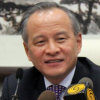 Cui, Tiankai
Cui Tiankai presented his credentials as ambassador of the People’s Republic of China to the United States to President Barack Obama on April 15, 2013.
Cui was born in October 1952 in Ningbo, Zhejiang Province, near Shanghai. In the early 1970s, he spent five years as a farmhand during the Cultural Revolution, the period in which many urban Chinese were forced back to the land in a kind of spiritual cleansing effort by the Chinese Communist Party. Cui later became one of the first Chinese officials to speak of his experience during the Cultural Revolution.
He attended East China Normal University, studying foreign languages. After his 1979 graduation, Cui spent two more years at a special school for interpreters. This led in 1981 to his being assigned to the United Nations as an interpreter.
In 1984, Cui returned to China to serve as the third secretary in the International Organizations and Conferences department of the Ministry for Foreign Affairs. Cui returned to the United States in 1986 for postgraduate work at Johns Hopkins University. He earned his Master’s in Public Administration at Hopkins’ School of Advanced International Studies in 1987. He then returned to the International Organizations and Conference department and was named head of that department in 1988, a post he held for eight years.
Cui’s profile was raised in 1996 when he was named a deputy director and spokesman for China’s Foreign Affairs ministry. As such, he was a frequent source in Western media reports on China. In 1997, Cui was sent back to New York, this time as counselor in the Chinese mission to the UN.
In 1999, Cui returned to China to a position in the Policy Research Office, first as deputy director, then in 2001 as director. Cui moved to Foreign Affairs’ Asian Affairs Department in 2003 as director.
Cui was named assistant foreign affairs minister in 2006. One of his more prominent taks in that position was to participate in talks with Russia and Iran about Iran’s nuclear program.
In 2007, Cui took over as China’s ambassador to Japan. While in that job, he was outspoken on Japan’s role in World War II and some of its leaders’ attempts to downplay their country’s role as an aggressor in that conflict.
In 2010, Cui was named vice minister for Foreign Affairs. While there, at times he showed his ability to hew to the party line but in other instances he showed his skill in defusing tricky situations. When Chinese dissident Liu Xiaobo was named winner of the 2010 Nobel Peace Prize, Cui was outspoken in trying to intimidate other nations into boycotting the Nobel ceremony, an attempt that was mostly unsuccessful. However in 2012, when civil rights activist Chen Guangcheng took refuge in the U.S. Embassy in Beijing and eventually requested safe passage to the United States, Cui helped resolve the situation by allowing Chen’s departure from China.
Since taking his post in Washington, Cui has seemingly become immersed in American culture. He took his wife, Ni Peijun, to the Super Bowl last February and was photographed on the sidelines. In March 2014, he told a panel in Beijing “I have seen both seasons of ‘House of Cards,’ which I think embodies some of the characteristics and corruption that is present in American politics.”
Cui has a reputation as a troubleshooter. “Cui is very good to have at the center of U.S.-China relations,” said Kenneth G. Lieberthal, a senior fellow at the Brookings Institution. “That's not because he's pro-U.S. but because he’s a subtle and wide-ranging thinker. He represents China's interests and then understands what might be accomplished.”
Cui and his wife have a daughter.
-Steve Straehley
To Learn More:
Behind Scenes, China’s Envoy Aims to Allay Tensions With U.S. (by Jane Perlez, New York Times)
- Table of Contents
- News
- Overview
- Basic Information
- History
- Newspapers
- History of U.S. Relations with China
- Current U.S. Relations with China
- Where Does the Money Flow
- Controversies
- Human Rights
- Debate
- Past Ambassadors
- Ambassador to the U.S.
- Embassy Web Site in the U.S.
- Comments
- Leave a comment


U.S. Ambassador to China

After Donald Trump repeatedly bashed China during his presidential campaign, it made sense that he choose someone as ambassador who might be able to smooth things over. Trump may have found his man in Iowa Governor Terry Branstad (R), whom Trump nominated for the post on December 7, 2016, and whom the U.S. Senate confirmed in an 82-13 vote on May 22, 2017.
Branstad was born in Leland, Iowa, on November 17, 1946, to Edward and Rita Branstad, who were farmers. Branstad grew up on the farm, graduated from Forest City High School in 1965 and went off to the University of Iowa, where he earned a B.A. in political science and sociology in 1969.
Branstad then took a detour into the Army, where he served as a military policeman at Fort Bragg, North Carolina. Years later, Branstad would gain credibility with conservatives for a story that he arrested actress Jane Fonda as she protested at the base. The truth of the story, according to Branstad, was that he had recommended that she not be allowed on base to protest. Fonda came on the base anyway and was arrested by others in Branstad’s unit.
Branstad got out of the Army in 1971 and went to Drake Law School, earning his J.D. in 1974. Even before then, however, Branstad entered politics, taking a seat in the Iowa Assembly in 1973. He served three terms in the Assembly before becoming lieutenant governor in 1979. Four years later, at age 37, he became the youngest governor in Iowa’s history.
It was during Branstad’s first stint as governor, in 1985, that he met Xi Jinping, who is now president of China. Xi traveled to Iowa with a delegation from his home province and stayed in the small town of Muscatine. Xi returned to the town on a visit in 2012 when he was China’s vice-president. Branstad served as governor until 1999.
After he left office, Branstad practiced law with the firm of Kaufman, Patee, Branstad & Miller; was a financial adviser for Robert W. Baird and Company; and had his own business, Branstad and Associates. In 2003, Branstad was named president of the Des Moines University School of Medicine. He remained there until deciding to run for re-election as Iowa governor. He easily won, and resumed his spot in the statehouse in 2011. Branstad was successful in selling Iowa agricultural products, particularly pork and soybeans, to China.
Branstad was an early supporter of Trump’s presidential campaign. He was mentioned shortly after the election as a likely candidate for the Beijing post, even drawing supportive comments from the Chinese. “First of all, I would like to say that Mr. Branstad is an old friend of the Chinese people and we welcome him to play a greater role in promoting Sino-U.S. relations,” Chinese government spokesman Lu Kang said, according to The Washington Post.
Branstad will leave Des Moines as the longest-serving governor in U.S. history at 22 years, not including the gap in service. He’ll also leave office having never lost an election.
Branstad and his wife, Christine, have three adult children: Eric, who ran Trump’s Iowa campaign; Allison; and Marcus.
-Steve Straehley
To Learn More:
Terry Branstad, Iowa Governor, Is Trump’s Pick as China Ambassador (by Binyamin Appelbaum, New York Times)
10 Things to Know About Iowa Gov. Terry Branstad, Trump’s Pick for Ambassador to China (by Amber Phillips, Washington Post)
An “Old Friend” of Xi Jinping Will Be America’s Next Ambassador to China (The Economist)
morePrevious U.S. Ambassador to China
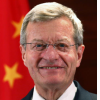
Max Baucus was sworn in as ambassador to the People’s Republic of China on February 21, 2014, after being nominated by President Barack Obama on January 7, 2014. Baucus replaced former Washington Governor Gary Locke in the position.
Baucus was born Max Sieben Enke on December 11, 1941, in Helena, Montana. His mother Jean came from a well-to-do ranching family in Helena and was attending Stanford, while his biological father, Stephen Enke, taught economics at that university. Enke later was controversial for some of his theories on population control (such as paying Indian men to be sterilized). Max lived for two years in California before his parents divorced and his mother brought him and a younger sister back to Helena. Baucus had little to do with Enke from that point.
In 1946, Max’s mother married John J. Baucus, who later adopted Max and his sister. Baucus attended Helena High School, playing football there, and graduating in 1959. He went to Carlton College for one year, and then transferred to Stanford, from where he graduated with a degree in economics in 1964. While a student, Baucus took time to hitchhike his way around the world. He remained in Palo Alto for law school, earning his J.D. in 1967.
Baucus’ first job out of law school was as a staff attorney for the federal Civil Aeronautics Board, which at that time controlled fares and routes of commercial airlines. He later took a similar position with the Securities and Exchange Commission.
In 1971, Baucus returned to Montana. He took a position with the 1972 state constitutional convention, which was rewriting that state’s governing document. Baucus eventually was made executive director of the convention. What was eventually adopted was called by some one of the most progressive constitutions in the nation.
By 1973, Baucus was working for a law firm in Missoula and was a member of the state legislature. He made the leap to Congress the next year, representing the western half of the state (Montana then had two representatives in the House). As part of his first campaign, he walked across the large district to gain name recognition. Baucus served two terms in the House before running for the Senate in 1978. He won easily, as he did most of his subsequent races through the final one in 2008.
As a senator, Baucus was a moderate, often working with Republicans on their programs to the consternation of his fellow Democrats. One example of this was on tax policy. Baucus voted for the George W. Bush tax cuts, opposed repeal of the cuts and has championed elimination of the estate tax. Another was on gun safety issues; he voted against the Manchin-Toomey background checks proposal.
As chairman of the Senate Finance Committee, Baucus was a key player in President Obama’s fight to enact health-care legislation. One of Baucus’ first moves was to declare that single-payer healthcare, that is, a system like Medicare where the federal government manages payments to doctors, was not a possibility. Some tied this stance to the large contributions Baucus received over the years from the healthcare industry.
Baucus originally supported the war in Iraq. However, a nephew, Marine Cpl. Phillip E. Baucus, was killed in Iraq in 2006. The following January, Baucus spoke in opposition to the war, saying “If I knew then what I know now I never would have voted for the war.”
On April 23, 2013, Baucus announced that he would not run for re-election when his sixth term expired in 2014. In December 2013, Obama announced his intention to nominate Baucus for the post in Beijing. Baucus’ nomination was approved 96-0 by the Senate, with the nominee himself voting “present.”
Baucus has a son, Zeno, with his first wife Ann Geracimos, a journalist. Zeno is now an assistant U.S. Attorney in Montana. Baucus married his second wife, Wanda, in 1984. They were divorced in 2009. In 2011, Baucus married Melodee Hanes, who had worked in his state office. Prior to their marriage, Baucus nominated Hanes to be U.S. Attorney in Montana, but Hanes withdrew from consideration for the post.
-Steve Straehley
To Learn More:
Ranch Roots To D.C. Career: Democrat Baucus Running For 6th Term In U.S. Senate (by Jennifer McKee, Missoulian)
more
Comments