



Togo was originally established by Ewe people who migrated from the Niger River Valley. In the 15th and 16th centuries, it was ruled by the Portuguese. It became known as the Slave Coast for its extensive role in the West African slave trade. In the 1800s, Germany took control of Togo, ruling until 1914, when French and British forces invaded. France and Britain jointly administered Togo as a UN trust territory after World War II, but in April 1960, Togo severed ties with France and became fully independent. Togo’s first president, Sylvanus Olympio, was assassinated in 1963. For the next several decades, Togo went back and forth between a multi-party system and complete military dictatorship. Numerous coups gave rise to violence that displaced more than 300,000 Togolese to Benin and Ghana.
Lay of the Land: On the southern coast of West Africa, Togo is bounded on the north by Burkina Faso, on the east by Benin, on the south by the Gulf of Guinea, and on the west by Ghana. This narrow strip of ground rises from the gulf to a plateau, which leads to the Atakora Mountains in the middle of the country. To the north are the Oti river valley and gently rolling grasslands.
The Ewes, who moved into the area from the Niger River Valley between the 12th and 14th centuries, originally founded Togo. Two hundred years later, Portuguese explorers and traders visited the coast of Togo, which quickly became a major center for the slave trade and known as the “Slave Coast.” The trade continued for 200 years, until slavery died out in the US and other countries.
Diplomatic relations between the United States and Togo were established in April 1960, with Leland Barrows serving as the first US ambassador to the country.
Relations between the US and Togo are cordial. Since Togo became a market-oriented economy, the two countries have developed relations along economic lines. However, the United States has never been one of Togo’s major trade partners.
US imports from Togo totaled 9.1 million in 2010, while US exports to Togo amounted to $169.8 million.
Colombian Drug Lord Extradited from Togo to US
According to the State Department, human rights problems included: “security force use of excessive force, including torture, which resulted in several injuries; official impunity; harsh and life-threatening prison conditions; arbitrary arrests and detention; lengthy pretrial detention; executive influence over the judiciary; infringement of citizens’ privacy rights; restrictions on freedoms of press, assembly, and movement; official corruption; discrimination and violence against women; child abuse, including female genital mutilation (FGM), and sexual exploitation of children; regional and ethnic discrimination; trafficking in persons, especially women and children...” and societal discrimination.
Note: The Embassy in Lomé was established on Apr 27, 1960, with Jesse M. MacKnight as Chargé d’Affaires ad interim.
Appointment: Jun 23, 1960
Presentation of Credentials: Aug 22, 1960
Termination of Mission: Superseded, Jun 27, 1961
Note: Also accredited to Cameroon; resident at Yaounde.
Appointment: Apr 18, 1961
Presentation of Credentials: Jul 27, 1961
Termination of Mission: Left post Feb 24, 1964
Appointment: Jun 8, 1964
Presentation of Credentials: Jul 10, 1964
Termination of Mission: Left post May 8, 1967
Appointment: Sep 13, 1967
Presentation of Credentials: Oct 13, 1967
Termination of Mission: Left post Mar 5, 1970
Note: Also accredited to Equatorial Guinea; resident at Lomé.
Appointment: Sep 8, 1970
Presentation of Credentials: Oct 8, 1970
Termination of Mission: Left post Apr 3, 1974
Appointment: Feb 11, 1974
Presentation of Credentials: Jun 7, 1974
Termination of Mission: Left post Aug 8, 1976
Appointment: Sep 16, 1976
Presentation of Credentials: Oct 28, 1976
Termination of Mission: Left post Jul 15, 1978
Appointment: Sep 23, 1978
Presentation of Credentials: Nov 3, 1978
Termination of Mission: Left post Jul 29, 1981
Appointment: Mar 9, 1982
Presentation of Credentials: Apr 19, 1982
Termination of Mission: Left post Jun 9, 1984
Appointment: Jun 28, 1984
Presentation of Credentials: Jul 31, 1984
Termination of Mission: Left post Jul 5, 1986
Appointment: Oct 16, 1986
Presentation of Credentials: Nov 4, 1986
Termination of Mission: Left post Apr 4, 1988
Appointment: Apr 28, 1988
Presentation of Credentials: Jun 20, 1988
Termination of Mission: Left post Sep 4, 1990
Appointment: Oct 22, 1990
Presentation of Credentials: Dec 3, 1990
Termination of Mission: Left post Jul 16, 1994
Appointment: May 9, 1994
Presentation of Credentials: Oct 7, 1994
Termination of Mission: Left post Nov 21, 1997
Appointment: Nov 11, 1997
Presentation of Credentials: Jan 7, 1998
Termination of Mission: Left post Jul 30, 2000
Appointment: Sep 15, 2000
Presentation of Credentials: Oct 17, 2000
Termination of Mission: Left post Dec 14, 2002
Appointment: Apr 16, 2003
Presentation of Credentials: May 22, 2003
Termination of Mission: Left post Apr 1, 2005
Appointment: Nov 2, 2005
Presentation of Credentials: Feb 2, 2006
Termination of Mission: August 2008
 Bariki, Limbiye
Limbiye Edawe Kadangha Bariki became the Togolese ambassador to the US on July 14, 2009.
- Table of Contents
- News
- Overview
- Basic Information
- History
- Newspapers
- History of U.S. Relations with Togo
- Current U.S. Relations with Togo
- Where Does the Money Flow
- Controversies
- Human Rights
- Debate
- Past Ambassadors
- Ambassador to the U.S.
- Embassy Web Site in the U.S.
- Comments
- Leave a comment

U.S. Ambassador to Togo
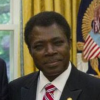
The new ambassador from the small West African nation of Togo should have no problem finding his way around Washington, DC, for he has lived and worked there for about two decades.
Frédéric Edem Hegbe was appointed on January 19, 2017, by Togolese President Faure Gnassingbé. He presented his credentials to President Donald Trump on April 27, 2017, using the occasion to express his country’s desire to work with the U.S. in the context of the African Growth Opportunity Act and the Millennium Challenge Corporation, perhaps not knowing that Trump intends to cut foreign aid substantially. He also stated that Togo looks forward to the upcoming Africa-Israel Summit, which is set for October 23 to 27 in Lomé, the capital of Togo.
Hegbe was born on April 27, 1951, nine years before Togo declared its independence from France, which had ruled the country since World War I.
Hegbe has worked as a professor and director at the College d’Enseignement General, Togo. A “CEG” is a postsecondary educational institution roughly equivalent to an American junior college.
Hegbe has been with the Togo Ministry of Foreign Affairs since 1978, where he has served as head of protocol and consular affairs. Foreign postings have included service as first secretary at the Togolese embassy in Kinshasa, Zaire (now Democratic Republic of Congo), and as
economic and commercial counselor in Washington, DC.
Hegbe has served as chargé d’affaires at Togo’s embassy in Washington since 1993, including a two-year stint as interim chief of mission from 1993 to 1995.
For a few years, at least roughly 2012 to 2014, Hegbe worked as a contract training instructor for the State Department’s Foreign Service Institute, where he taught French. In 2014, he was a GG-11 under the grades similar to the general schedule pay scale, earning roughly $75,000 a year.
Frédéric Hegbe is married to Ameyo Hegbe, with whom he has at least three children, Komi, Wisdom, and Elie. Hegbe has, apparently, had some run-ins with law enforcement over traffic violations, including speeding and driving without a license.
Hegbe succeeds Limbiye Kadangha Bariki, who served as ambassador from 2009 to 2015.
-Matt Bewig
To Learn More:
Donald Trump reçoit le nouvel ambassadeur togolais (Togo Tribune)
Le Togo a un nouvel ambassadeur nommé aux USA (ici Lomé)
morePrevious U.S. Ambassador to Togo

On October 17, 2011, President Barack Obama announced his intent to appoint as ambassador to the small West African nation of Togo a veteran diplomat who has spent years focusing on Africa–US relations. Robert E. Whitehead was confirmed by the Senate on March 29, 2012.
Comments