



The most populous country in Central Asia, Uzbekistan was of little interest to the outside world until, in the days following the terrorist attacks of September 11, 2001, the United States was attracted to its 85-mile border with Afghanistan. Although 80% of the 26 million citizens are Uzbeks, there are significant minorities of Russians and Tajiks. Uzbeks themselves also live in neighboring countries, such as Turkmenistan and Kyrgyzstan, where they make up 13% of the population, and Tajikistan, where they account for almost a quarter of the population. There are also two million Uzbeks in Afghanistan. Uzbekistan is an oddly-shaped nation, the product of the Stalinist equivalent of gerrymandering. In fact, there are four parts of Uzbekistan that are surrounded on all sides by Kyrgyzstan. Besides the capital of Tashkent, Uzbekistan includes the ancient Silk Route cities of Samarkand and Bukhara, part of the ecologically-ruined Aral Sea and, in the east, most of the densely populated and politically volatile Fergana Valley. Most Uzbeks are Sunni Muslims and 99% are literate. Uzbekistan is the world’s second largest exporter of cotton (behind the United States), and it is one of the only nations in the world that is self-sufficient in oil.
Lay of the Land: Flat-to-rolling sandy desert with dunes; broad, flat, intensely irrigated river valleys along Amu Darya, Syr Darya; shrinking Aral Sea; semiarid grasslands surrounded by mountainous Tajikistan and Kyrgyzstan in east.
The United States recognized Uzbekistan as an independent state in December 1991. Diplomatic relations were established in February 1992, following a visit by Secretary of State James Baker to the republic, and the United States opened an embassy in Tashkent the following month.
US-Uzbek relations cooled significantly following the “color revolutions” in Georgia, Ukraine, and Kyrgyzstan in 2003-2005. At this time the government of Uzbekistan sought to limit the influence of US and other foreign non-governmental organizations (NGOs) working on civil society, political reform, and human rights inside the country. Relations deteriorated rapidly following US and European demands for an independent, international investigation into the May 2005 Andijan violence.
Uzbekistan’s strategic importance to the United States goes beyond its geopolitical location vis-à-vis Afghanistan. The Central Asian country is also a major supplier of uranium. In fact, the sale of this and other nuclear fuels from Uzbekistan to the US constitutes the majority of all trade between the two nations. In 2008, the US imported a total of $292 million in goods from Uzbekistan—of which, $285 million was nuclear materials and other fuels.
US Ambassador Sees Changes in Human Rights for Uzbekistan
In 2003, Uzbekistan President Islam Karimov ordered parliament to pass a law that made him and all members of his family immune from prosecution forever. Later he made it illegal to refuse to praise him and his policies during religious services. Actually insulting him was punishable by up to five years in prison. He also criminalized placing loyalty to Islam above loyalty to the nation’s leaders. For good measure, Karimov banned the study of Arabic, which was being used by students and scholars to read the Quran in its original language.
Note: The United States recognized Uzbekistan on Dec 25, 1991, and established diplomatic relations on Feb 19, 1992. Embassy Tashkent was established Mar 16, 1992, with Michael Mozur as Chargé d'Affaires ad interim.
Appointment: Aug 11, 1992
Presentation of Credentials: Sep 9, 1992
Termination of Mission: Left post Sep 30, 1995
Appointment: Aug 30, 1995
Presentation of Credentials: Oct 12, 1995
Termination of Mission: Left post Oct 3, 1997
Appointment: Nov 10, 1997
Presentation of Credentials: Dec 3, 1997
Termination of Mission: Left post Oct 23, 2000
Appointment: Sep 15, 2000
Presentation of Credentials: Nov 1, 2000
Termination of Mission: Left post Jul 12, 2003
Appointment: Dec 12, 2003
Presentation of Credentials: Jan 28, 2004
Termination of Mission: Left post, Apr 28, 2007
 Gulyamov, Bathiyar
Bakhtiyar Gulyamov presented his credentials as ambassador to the United States to President Barack Obama on July 18, 2013. It was the third ambassadorial posting for the career civil servant.
Gulyamov was born February 18, 1964, in Moscow. He graduated from Tashkent State University in 1986 with a degree in the history of Arab countries and later attended the Academy on State and Social Construction, an institution for the education of government officials, earning a Master’s degree in international relations in 1999.
In 1986, Gulyamov began a three-year tour in the Soviet army, working as an interpreter. After his military service, Gulyamov worked for the Tashkent Technical Institute as an inspector, and in 1991 took a position in the Uzbekyengilsanoat, an Uzbek business promotion organization.
Gulyamov joined Uzbekistan’s Foreign Ministry in 1992, working in the consular department. In 1995, he landed his first overseas posting, as second secretary in Uzbekistan’s embassy in London. Gulyamov served there for three years before returning home in 1998 to be first secretary in the ministry’s Department of Political Analysis and Forecasting.
In 2001, Gulyamov was posted abroad once again, this time as first secretary in his nation’s embassy in Japan. He returned home in 2003 to become head of the Foreign Ministry department dealing with the United Nations and other international organizations.
Gulyamov’s first ambassadorial post came in 2005, when he was chosen to head Uzbekistan’s delegation to Germany. Eventually, he was named ambassador to Switzerland, Sweden and the Czech Republic as well, serving in those posts from Berlin. He moved to Brussels in 2010 to head the Uzbek mission to Belgium, as well as be his country’s representative to the European Union and to the North Atlantic Treaty Organization.
Since being posted to Washington in 2013, Gulyamov has spent much of his time promoting U.S.-Uzbekistan trade. He has taken criticism for his country’s practice of using child labor to plant and harvest crops, as well as other human rights violations. Gulyamov was also accredited as his country’s ambassador to Canada in March 2014.
Gulyamov is married with two children. He speaks Arabic, English and Russian.
-Steve Straehley
To Learn More
- Table of Contents
- News
- Overview
- Basic Information
- History
- Newspapers
- History of U.S. Relations with Uzbekistan
- Current U.S. Relations with Uzbekistan
- Where Does the Money Flow
- Controversies
- Human Rights
- Debate
- Past Ambassadors
- Ambassador to the U.S.
- Embassy Web Site in the U.S.
- Comments
- Leave a comment


U.S. Ambassador to Uzbekistan
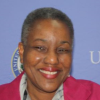
The Senate Foreign Relations Committee approved the nomination of career Foreign Service officer Pamela L. Spratlen as U.S. ambassador to Uzbekistan on September 18, 2014. If confirmed for the post by the full Senate, it will be the second ambassadorial post for Spratlen, who’s currently ambassador in the Kyrgyz Republic.
She was born in Columbus, Ohio and raised in Washington State and California. Her father, Thaddeus Spratlen, was a professor in the Department of Marketing at the University of Washington’s School of Business. As a younger man, he also applied to join the Foreign Service, but was blocked by more racially restrictive hiring policies by the State Department at that time. Her mother, Lois Price Spratlen, was an associate professor in the University of Washington’s School of Nursing, the university’s ombudsman and the author of African American Registered Nurses in Seattle: The Struggle for Opportunity and Success.
Spratlen graduated from Crenshaw High School in Los Angeles in 1972 and earned an A.B. in Psychology from Wellesley College in 1976. After graduation, she returned to California to work for Los Angeles-based Volunteers in Service to America (VISTA) and other public service organizations.
In 1981 she received her M.A. from the School of Public Policy at the University of California-Berkeley, and attended the U.S. Army War College, earning a Master’s in Strategic Studies in 2006.
From 1981 to 1989, Spratlen served as senior consultant to the California Legislature’s Joint Legislative Budget and Assembly Ways and Means Committees, advising them on oversight of the state’s $3 billion higher education budget.
In 1990, Spratlen joined the U.S. State Department as an economic officer, serving in Guatemala for two years. She served at the U.S. Mission to the Organization of American States from 1992 to 1994 and at the U.S. Mission to the Organization for Economic Cooperation and Development from 1995 to 1998. In 1999 she advanced to the executive secretariat and served as special assistant to the Counselor of the Department of State, working as a member of the team responsible for planning the official travels of Secretary Madeleine Albright. In that capacity, Spratlen went to the U.S. Embassy in Moscow in January 1999 to help lay the groundwork for Albright’s meetings with the Russian Federation on the subject of the Kosovo situation.
She was assistance coordinator at the U.S. Embassy in Moscow (2000-2002) and then became Vladivostok consul general, a position she held from 2002 to 2004. She then spent a year as diplomat-in-residence at Hawaii’s East West Center. In 2005-2006, she was special assistant to the counselor of the State Department.
Spratlen went on to serve as director of Central Asian Affairs (2006-2007), during which time she was the deputy to the special envoy for human rights in North Korea. For six months she was acting deputy assistant secretary for Central Asia, and she served as director of the Bureau of European Affairs.
After serving as deputy chief of mission at the U.S. Embassy in Astana, Kazakhstan, Spratlen was sworn in as U.S. ambassador to the Kyrgyz Republic on April 15, 2011. In June 2014, she helped coordinate the handover of Manas Air Base, which had been an important transit base for troops and supplies going into Afghanistan, to the Kyrgyz government.
Spratlen speaks Russian, French and Spanish. One of her sisters, Pat Spratlen Etem, was a member of the 1980 and 1984 Olympic rowing teams.
-Danny Biederman, Steve Straehley
To Learn More:
An Interview with Pamela Spratlen, U.S. Ambassador to Kyrgyzstan (by Jason Parisi, The Politic)
Testimony to Senate Foreign Relations Committee (pdf)
State Department Cables 2006-2010 (WikiLeaks)
morePrevious U.S. Ambassador to Uzbekistan

George A. Krol was nominated by President Barack Obama to be ambassador to Kazakhstan on May 1, 2014. If confirmed by the Senate, it will be the third ambassadorial post for the career Foreign Service officer.
Krol was born in Pittsburgh, Pennsylvania, in 1956, and raised in Manchester Township, New Jersey, the youngest of three sons of Mr. and Mrs. Anthony J. Krol. He attended St. Peter’s Preparatory School in Jersey City, and earned a Bachelor’s degree in History, magna cum laude, at Harvard University. At Oxford University in England he received both Bachelor’s and Master’s degrees in Philosophy, Politics and Economics.
Krol taught at the National War College, and joined the U.S. Foreign Service in 1982, taking assignments for the State Department in India, Poland and the Ukraine. In 1991, he was the U.S. consul in Leningrad (now St. Petersburg). From 1993 to 1995, he served as deputy chief of mission and chargé d’affaires in Minsk, Belarus. Between 1995 and 1997, he was special assistant to the Ambassador-at-Large for the New Independent States, and from 1997 to 1999 he served as director of the Office of Russian Affairs—both positions based in Washington, D.C.
In 1999, Krol was named minister-counselor for Political Affairs at the U.S. Embassy in Moscow, Russia, a post he held through 2002. The following year he was appointed U.S. ambassador to Belarus, a position he held through 2006.
In April 2007, President George W. Bush announced his intention to nominate Krol to be the U.S. ambassador to Turkmenistan, but he was never confirmed, although the reasons are unclear. Krol subsequently served as deputy assistantsSecretary for South and Central Asian Affairs. Among his responsibilities was engaging in direct consultation with Uzbek government officials.
Krol was nominated to be ambassador to Uzbekistan in July 2010 and assumed the post about a year later. While there, he has taken criticism from human rights groups in the country for deferring to the regime of Islam Karimov, under which there are frequent rights violations, including forced labor of its citizens, and little freedom of expression. However, Uzbekistan has been a vital part of the U.S. supply train to American forces in Afghanistan.
Krol is married to Melissa Welch.
-Danny Biederman, Steve Straehley
more
Comments