



Slovenia is a country in Eastern Europe that occupies an area slightly smaller than the state of New Jersey. Bordered by Italy, Austria, Croatia and Hungary, Slovenia was originally settled by Celts and Illyrians. Slavic settlements sprang up in the area around 500 AD, unifying under a common language and customs. Slovenia was ruled by the Holy Roman Empire, before becoming part of the Habsburg Empire from the 14th century until 1918. At that time, Slovenia joined with other Slavic states to form the Kingdom of Serbs, Croats and Slovenes as part of the peace process following World War I. In 1929, it was renamed the Kingdom of Yugoslavia and governed by a Serbian monarchy. During World War II, Yugoslavia was occupied by Axis troops. Following the war, Josip Tito assumed the leadership of communist Yugoslavia and ruled until his death in 1980. In 1989, Slovenia seceded from Yugoslavia, and fought a relatively bloodless but ultimately victorious 10-day war for its independence, which became official in 1991. Since then, Slovenia has pursed a path of openness with the United States and the rest of Europe, joining NATO and the European Union in 2004, and participating in World Trade Organization activities, as well as peacekeeping missions in Iraq, Afghanistan, Bosnia, Kosovo and elsewhere. Slovenia also adopted the Euro as its currency on January 1, 2007.
Lay of the Land: Slovenia occupies an area slightly smaller than the state of New Jersey. Its capital is Ljubljana, and the country’s terrain is mountainous in the north, with wide plateaus in the southeast and a region of limestone caves near the Adriatic Coast.
Slovenia’s history dates to ancient times, when Celts and Illyrians inhabited present-day Slovenia. In the 1st century, the Roman Empire established its rule over this territory, after 200 years of fighting with local tribes.
Slovenians arrived early in the New World. In 1680, a Jesuit priest by the name of Ivan Ratkaj set foot on America’s shores, and was followed seven years later by Mark Anton Kappus, a man respected for his work as a writer, missionary, and explorer.
Famous Slovenian Americans:
The US imported a total of $387.1 million worth of goods from Slovenia in 2009, and exported $241.2 million, translating into a trade deficit of $145.9 million for the US. This is considerably lower than the year before, when US imports totaled $466.5 million and exports $309.6 million.
Case backlogs in Slovenian courts have sometimes resulted in lengthy delays in trials, according to the State Department. The judicial system was overburdened and lacked administrative support, and as a result, the judicial process frequently was protracted. In many cases during the year, criminal trials lasted from two to five years. According to the State Department, “some claimants have complained of a general lack of transparency, bias, and potential conflicts of interest on the part of adjudicators, and procedures that were inconsistent with the law.” An effort to initiate a program for the restitution of Jewish communal property has encountered a number of delays.
Note: The United States recognized the independence of Slovenia Apr 7, 1992, and established diplomatic relations with it Aug 6, 1992. Embassy Ljubljana was opened Aug 25, 1992, with E. Allan Wendt as Chargé d’Affaires ad interim.
Appointment: May 15, 1993
Presentation of Credentials: May 26, 1993
Termination of Mission: Left post Sep 12, 1995
Note: An earlier nomination was not acted upon by the Senate.
Appointment: Aug 14, 1995
Presentation of Credentials: Sep 14, 1995
Termination of Mission: Left post Feb 13, 1998
Appointment: Jun 29, 1998
Presentation of Credentials: Sep 2, 1998
Termination of Mission: Left post Sep 27, 2001
Appointment: Aug 7, 2001
Presentation of Credentials: Oct 24, 2001
Termination of Mission: Left post Sept 17, 2004
Appointment: May 12, 2004
Presentation of Credentials: Sep 29, 2004
Termination of Mission: Left post, Aug 20, 2007
Note: Nomination of Jul 24, 2007 withdrawn Sep 7, 2007
Appointment: May 15, 2008
Presentation of Credentials: 2008
Termination of Mission: January 20, 2009
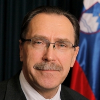 Cerar, Božo
Career diplomat Božo Cerar presented his credentials as Slovenia’s ambassador to the United States on September 17, 2013. Washington is the fourth ambassadorial post for Cerar.
Cerar was born October 16, 1949. He graduated with a degree in law from the University of Ljubljana in 1973 in what was then Yugoslavia. The following year Cerar joined the Yugoslav foreign service as a trainee and began to work his way up the ladder. His first overseas posting was in 1977 in Sydney, Australia, as vice consul. Cerar served there until 1981, when he was named secretary for the Slovenian Trade Union Committee for International Cooperation. In 1985, Cerar was posted to Athens, Greece, as first secretary in the Yugoslav embassy.
Cerar returned to Belgrade and in 1990 was named the foreign ministry’s head of department for Western Europe.
Yugoslavia was crumbling at that time and in 1991, Cerar declared his allegiance to the new Republic of Slovenia. During the fighting that was going on, he worked to get Slovenia’s message out to foreign officials and news agencies. Cerar then coordinated the activities of European Union peacekeeping troops with the Slovenian government. Later that year, he was named the Slovenian foreign ministry’s head of department for Europe and North America.
In 1992, Cerar was sent to London as chargé d’affaires, a post he held until 1996. He then returned to Slovenia as the state undersecretary and head of the office of the minister of foreign affairs. The following year, Cerar was given his first posting as ambassador, representing Slovenia in Canada.
Cerar stayed in Ottawa until 2001, when he came home to be the foreign ministry’s head of department for multilateral relations, and the following year, head of department for the North Atlantic Treaty Organization (NATO), holding that post until 2003.
In 2004, Cerar was named ambassador to Poland. He served in that position only a short time before returning to Slovenia in 2005 to be state secretary, or deputy minister, in the foreign ministry. In 2007, Cerar became Slovenia’s representative to NATO. He returned to Ljubljana to serve again as state secretary in the foreign ministry in 2012.
Cerar took time to further his studies during his career, earning a Master’s in diplomatic studies from Westminster University in London in 1993 and a Ph.D. in international law from the University of Ljubljana in 1997.
Since coming to Washington, Cerar has been active in the Slovenian-American community, including a stint as a judge of a polka contest at the National Cleveland-Style Polka Hall of Fame in Cleveland. Cerar speaks English, Russian, Polish, Croatian, Greek and French. He’s married and has three children.
-Steve Straehley
To Learn More:
An Excerpt from the Diary of Ambassador Dr Božo Cera: June 1991
- Table of Contents
- News
- Overview
- Basic Information
- History
- Newspapers
- History of U.S. Relations with Slovenia
- Current U.S. Relations with Slovenia
- Where Does the Money Flow
- Controversies
- Human Rights
- Debate
- Past Ambassadors
- Ambassador to the U.S.
- Embassy Web Site in the U.S.
- Comments
- Leave a comment

U.S. Ambassador to Slovenia
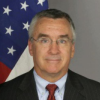
On July 29, 2014, the Senate Foreign Relations Committee approved the nomination of Brent Hartley, a career Foreign Service officer, to be the next U.S. ambassador to Slovenia. Hartley’s nomination awaits approval by the full Senate.
Hartley was born in Medford, Oregon, where his father, Jack, ran a hardware store. Hartley graduated from Medford High School in 1973 and went on to attend Hampshire College, earning a Bachelor of Science in U.S. history and international relations. During his senior year he interned at the State Department. He later earned an M.S. in strategic studies from the National War College.
He joined the Foreign Service in 1981 and his first overseas assignment came the following year in Cairo, Egypt, serving there for two years. Other early assignments were desk officer for the Conference for Security and Cooperation in Europe (the Helsinki Commission), policy analyst in the Bureau of Personnel, staff assistant in the Bureau of European Affairs and political officer in the Bureau of Egyptian Affairs.
In 1989, Hartley was named political and military officer at the U.S. Embassy in Rome. He followed that with assignments as Cyprus desk officer and deputy political advisor at the U.S. mission to the North Atlantic Treaty Organization (NATO). Hartley was named director for regional affairs in the Office of the Coordinator for Counterterrorism in 2003. Two years later, he took over as senior advisor for international relations at the National Counterterrorism Center.
In 2006, Hartley was named deputy director for European Regional Security Affairs. The following year he began a tour in Kabul, Afghanistan, as a counselor for military and political affairs at the U.S. Embassy. Hartley was brought home in 2008 to be director of the State Department’s Office of Pakistan Affairs.
In 2010 he was made director for European Security and Political Affairs and in 2012 Hartley was named deputy assistant secretary of state for European and Eurasian Affairs with responsibility for Nordic, Baltic and Central European countries. Some of his duties there have entailed testifying to Congress on the Russian invasion of Ukraine and Hungarian anti-Semitism and anti-Romani trends.
Hartley and his wife, attorney Elizabeth Dickinson, have two children, Ella and Charlie.
-Steve Straehley
To Learn More:
Away From Home for the Holidays (by Paul Fattig, Medford Mail Tribune)
Testimony before the Senate Committee on Foreign Affairs (pdf)
State Department Cables 2004-2008 (WikiLeaks)
morePrevious U.S. Ambassador to Slovenia
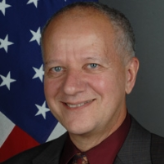
Joseph A. Mussomeli, a diplomat with three decades of experience, took over as U.S. ambassador to Slovenia in October 2010. He previously served as ambassador to Cambodia.
Comments