



Montenegro was part of the former Yugoslavia at one time. Illyrians originally settled the area, followed by the Greeks, Celts, Byzantines, Romans and the Slavs. The nation was eventually Christianized under Nicholas I and later united with Serbia to fight the Turks of the Ottoman Empire. Nicholas oversaw the expansion of Montenegro’s borders and led it toward independence in 1878. Italy occupied the country during World War II, and Montenegro adopted socialism as part of Yugoslavia during the Cold War. In 1992, Montenegro joined with Serbia as Yugoslavia began to break up, leaving behind a truncated Federal Republic of Yugoslavia. While Serbia became involved in the war in Bosnia, Montenegro remained largely out of the conflict. The Democratic Party of Socialists of Montenegro became the dominant political force in the country throughout the 1990s. During this time Montenegro became a hotspot for smuggling due to its location on the Adriatic Sea. In 2003, the Federal Republic of Yugoslavia renamed itself Serbia and Montenegro. This lasted until June 2006 when Montenegro became completely independent. The United States soon thereafter established diplomatic relations with Montenegro.
Lay of the Land: Montenegro occupies an area slightly smaller than the state of Connecticut, and lies between Bosnia and Herzegovina, Serbia, Kosovo and Albania. Its terrain is varied, from the mountainous regions with thick forests to central plains and the Adriatic coast, with a few small islands off the coast. The climate is generally continental, and Mediterranean off the coast.
The area now known as Montenegro was originally settled by the Illyrians before the 6th century. Subsequently, the Greeks and Celts formed settlements to enhance trade in the region. The Romans eventually conquered the Illyrian kingdom and divided the territory with the Byzantine Empire.
The Socialist Federal Republic of Yugoslavia was a conglomeration of six regional republics and two autonomous provinces that was roughly divided on ethnic lines. Following a string of violent conflicts during the 1990s Yugoslavia split into several independent countries, including Serbia and Montenegro,.
Notable Monenegrin-Americans
In 2009, the and the United States’ leading export to Montenegro were new and used passenger cars ($3.3 million) and drilling/oilfield equipment ($2.3 million). Other major exports included unmanufactured agricultural goods ($2 million), medicinal equipment ($1.3 million), generators and accessories ($1.1 million), plastic materials ($1.1 million), and household appliances ($1.1 million).
Montenegro Accused of Caving to US Pressure on Kosovo
According to the U.S. State Department, Montenegro’s government has been accused of “allowing police mistreatment of suspects in detention, substandard prison conditions, abusive and arbitrary arrests, police impunity, lengthy pretrial detention, delayed and inefficient trials, widespread perception of corruption in law enforcement agencies and the judiciary, physical assaults on journalists, excessive monetary judgments against the media for slander, denial of public and press access to information, mistreatment and discrimination against the large number of refugees and internally displaced persons, sectarian intolerance and homophobia, discrimination against women, trafficking in persons, and discrimination against ethnic minorities,” .
Note: The United States recognized the Republic of Montenegro on Jun 13, 2006 and established relations with it on Aug. 15. The US Consulate in Podgorica became an embassy Oct 5, 2006, with Arlene Ferrill as Charge d’Affaires ad interim.
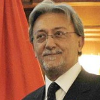 Kaluđerović,Nebojša
Nebojša Kaluđerović, who once served as his country’s foreign minister and is a career member of the diplomatic service, has been Montenegro’s ambassador to the United States since January 18, 2017. He is also the non-resident ambassador to Canada.
Kaluđerović was born December 17, 1955, in Nikšić, in what was then Yugoslavia. He graduated from secondary school there in 1974 and earned a B.A. in international relations at Belgrade University in 1979.
Kaluđerović joined Yugoslavia’s foreign service in 1981 as third secretary for international legal affairs in the Department for Research and Analysis and in 1984 was made an adviser in the cabinet of the deputy foreign minister. His first assignment in the United States came in 1986, when he was a third secretary in Yugoslavia’s delegation to the United Nations. Kaluđerović returned to Belgrade in 1991 as an adviser to the cabinet of the secretary for foreign affairs. He left the government the following year to work as a legal adviser. In 1994, Kaluđerović left for a long stint in Russia to work as a trade representative. He was first director of the Montex Trade Office in Krasnoyarsk, then in 1996 was marketing director of Zepter International in Moscow and then director of Jugoimport SDPR Trade Office, also in Moscow.
Kaluđerović returned to the foreign ministry in 2000 as assistant minister for multilateral affairs for the Republic of Montenegro. In 2002, he was named chief of cabinet for Montenegro’s president and beginning in 2003 held that job in the prime minister’s office.
Kaluđerović was named Serbia and Montenegro’s ambassador to the United Nations in 2004, along with representing his country in Cuba and Costa Rica. He later said that the part of the job he didn’t like was defending Serbia’s reluctance to participate in war crimes trials involving Serbian officials.
When Serbia and Montenegro split in 2006, in June Kaluđerović became Montenegro’s representative at the United Nations, running his country’s mission out of his son’s bedroom, and ambassador after that country became a member. While serving as UN ambassador, Kaluđerović was invited to speak at a New York meeting of the Nero Wolfe society, the Wolfe Pack, because the fictional detective created by Rex Stout was said to have been born in Montenegro.
Kaluđerović returned home in 2010 to be state secretary for political affairs at the Ministry of Foreign Affairs. He served for a few months in 2012, from July through December, as foreign minister and minister of European integration. The following year, he was made foreign policy adviser to the prime minister and was put in charge of Euro-Atlantic integration. Beginning in March 2015, he was Montenegro’s representative to the UN agencies in Geneva.
Kaluđerović’s main goal as ambassador was to help his country obtain full membership in the North Atlantic Treaty Organization (NATO). On April 11, 2017, U.S. President Donald Trump signed the U.S. instrument of ratification to approve Montenegro’s membership.
Kaluđerović is married and has an adult son. Kaluđerović speaks English and Russian.
-Steve Straehley
To Learn More:
A One-Man Embassy Adjusts to a Smaller Portfolio (by Catherine Elton, New York Times)
Montenegro’s Embassy in the US
- Table of Contents
- News
- Overview
- Basic Information
- History
- Newspapers
- History of U.S. Relations with Montenegro
- Current U.S. Relations with Montenegro
- Where Does the Money Flow
- Controversies
- Human Rights
- Debate
- Past Ambassadors
- Ambassador to the U.S.
- Embassy Web Site in the U.S.
- Comments
- Leave a comment

U.S. Ambassador to Montenegro
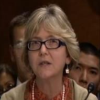
President Barack Obama nominated Margaret Ann Uyehara to be the U.S. ambassador to Montenegro on July 9, 2014. It would be the first ambassadorial posting for Uyehara, a career member of the Foreign Service.
Uyehara is from Berea, Ohio, and attended Kalamazoo College in Michigan, graduating in 1981 with a B.A. in political science.
Her first State Department posting was as a general services officer in the U.S. Embassy in Mali in 1983. In 1985, she was sent to the embassy in London as a consular officer. Other early overseas postings included disbursing officer at the embassy in Manila, Philippines, from 1989 to 1991; chief of special consular services at the U.S. Embassy in Tokyo from 1995 to 1998; liaison to the National Security Council for the 50th anniversary of the North Atlantic Treaty Organization summit; and from 1999 to 2002, Uyehara was a supervisory general services officer at the embassy in Jakarta, Indonesia.
Uyehara’s Washington assignments have included being a general services officer in the Bureau of Personnel from 1991 to 1993 and director of the Office of Allowances from 2002 to 2005.
In 2006, Uyehara was sent to Kyiv, Ukraine, as management counselor at the U.S. embassy. She was moved to Frankfurt, Germany, in 2008 as director of the Regional Support Center at the U.S. Consulate. In 2010, she was named management counselor for the Department of State at the U.S. Tri-Missions in Vienna, Austria.
Her most recent assignment was as executive director of the Bureaus of European and Eurasian Affairs and International Organization Affairs in the Department of State in Washington.
Uyehara’s husband, Michael, is also a Foreign Service office, currently serving in Belgrade, Serbia. They have three sons and two daughters. Uyehara speaks German, French, Ukrainian and Japanese.
-Steve Straehley
To Learn More:
Statement to the Senate Foreign Relations Committee (pdf)
morePrevious U.S. Ambassador to Montenegro
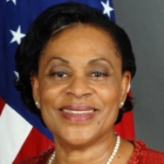
Sue K. Brown, a career member of the Senior Foreign Service, was appointed in November 2010 by President Barack Obama to serve as ambassador to Montenegro. She was sworn in on April 27, 2011.
Comments