



Lay of the Land: Botswana is a semi-arid, subtropical, landlocked country located in Southern Africa. It is bordered by South Africa to the south and southeast, Namibia to the west, Zambia to the north, and Zimbabwe to the northeast. The flat to gently rolling terrain is dominated by the Kalahari Desert, which comprises about 70% of Botswana’s total area of 231,788 square miles, making the country slightly smaller than the state of Texas. Owing to its aridity, Botswana is one of the most sparsely populated countries in Africa, as the country’s 1.8 million people are clustered mainly in the eastern third of the country. The capital and largest city is Gaborone, the fastest growing city in Africa, with a population of about 224,000.
Relations between the United States and Botswana have been friendly and cooperative since the latter’s independence in 1966. The U.S. has long supported Botswana because of its democratic traditions and political stability. Two key points of contact from the beginning were the Peace Corps and USAID. The Peace Corps first sent volunteers to Botswana in 1967, and continued to do for thirty years, ending the long relationship in 1997 because of the country’s growing prosperity. Similarly, in 1996 USAID phased out a longstanding partnership with Botswana, which included programs emphasizing education, training, entrepreneurship, environmental management, and reproductive health. USAID did not entirely leave Botswana, however, for its Southern Africa Global Competitiveness Hub, an initiative to help Southern African businesses sell more of their products on global markets, is headquartered in Gaborone. Further, the U.S. International Board of Broadcasters (IBB) operates a major Voice of America (VOA) relay station in Botswana, serving most of the African continent.
Botswana has aggressively promoted conservation, with the result that it is now one of the premier travel destinations for those wanting to view African wildlife in its natural habitat. Indeed, 17,670 Americans visited Botswana in 2004, an increase of 17.1% from the 15,087 that came to Botswana in 2003, mainly to go on safari in the country’s large national parks. Only 2,038 Batswana visited the U.S in 2006, a decrease of 10.2% from the 2,269 that visited in 2005. The number of visitors has fluctuated between a low of 1,873 in 2003 and a high of 2,273 in 2004.
Although agriculture (mainly subsistence farming and cattle raising) still provides a livelihood for more than 80% of the population, this sector supplies only about 50% of Botswana’s food needs and accounts for only 1.6% of GDP. Industry accounts for 51% of GDP, with 36% arising from diamond mining, which accounts for more than 70% of the country’s export earnings. In fact, Botswana is now the leading diamond producer in the world, selling about 25% of world production. Botswana’s economic growth has consistently been the highest in Africa, but the threat of HIV/AIDS to the demographic integrity of the population, and the expected fall off in diamond production starting around 2020, cloud the future economic horizon.
Botswana is one of only a few nations to sign an “impunity agreement” exempting U.S. personnel from the jurisdiction of the International Criminal Court.
Botswana has been a multiparty democracy since its independence in 1966. Its constitution provides for indirect election of a president and popular election of a national assembly. Since independence, Botswana has enjoyed an unbroken string of peaceful and fair elections, in which all parties were allowed to participate and the results have been implemented. The military has never attempted to seize power. In 2004 the Botswana Democratic Party (BDP), led by President Festus G. Mogae, returned to power in elections generally deemed free and fair. The BDP has held a majority of national assembly seats since independence. The civilian authorities generally maintained effective control of the security forces.
Name: Charles J. Nelson
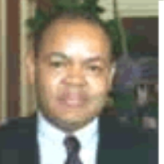 Lekoa, Lapologang Caesar
- Table of Contents
- News
- Overview
- Basic Information
- History
- Newspapers
- History of U.S. Relations with Botswana
- Current U.S. Relations with Botswana
- Where Does the Money Flow
- Controversies
- Human Rights
- Debate
- Past Ambassadors
- Ambassador to the U.S.
- Embassy Web Site in the U.S.
- Comments
- Leave a comment

U.S. Ambassador to Botswana
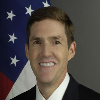
On July 29, 2014, the Senate Foreign Relations Committee held a hearing on the nomination of Earl Robert Miller, a career Foreign Service officer, to be the next U.S. ambassador to Botswana. It would be the first ambassadorial post for Miller. Botswana hosts the U.S. Air Force, and the United States is the leading purchaser of Botswana’s most important export: polished diamonds.
The son of Robert James Miller and Wanda Miller, Miller attended the University of Michigan, where he earned a B.A. in journalism in 1981. He went into the U.S. Marine Corps after graduation, serving on active duty until 1984. Miller then worked as a supervisor at Arantek, a Santa Clara, California, electronics company until 1987. He continued serving in the Marine Corps Reserve until 1992, doing a tour during the first Gulf War.
He then went into the Foreign Service, focusing on diplomatic security. Some of his early positions were Southern Africa desk officer for the Diplomatic Security Service (DSS), a DSS special agent in Miami, assistant regional security officer in El Salvador and a DSS special agent in San Francisco.
In 1995, Miller began his first tour in Botswana as a regional security officer (RSO) at the U.S. Embassy in Gaborone. He served there three years until he was brought back to the United States as the assistant special agent in charge for the DSS in Boston.
Miller went overseas again in 2000 as RSO at the U.S. Embassy in Kuala Lumpur, Malaysia. In 2003 he took on a similar post in Jakarta, Indonesia. While there, he helped investigate an August 31, 2002, terrorist ambush in Papua province that killed two U.S. schoolteachers and wounded eight other U.S. citizens, an investigation that lasted almost four years and culminated in the arrest of 12 terrorists.
In 2007, Miller was sent to Baghdad as RSO, leaving his wife Ana and their two sons, Andrew and Alexander, behind in Jakarta. He was assigned to the embassy in New Delhi, India, the following year, serving there until 2011.
In 2011, Miller was named consul general at the U.S. consulate in Johannesburg, South Africa, where he served until his nomination to the Botswana post.
Miller speaks Indonesian, Spanish and French.
-Steve Straehley
To Learn More:
Testimony before the Senate Committee on Foreign Relations (pdf)
morePrevious U.S. Ambassador to Botswana
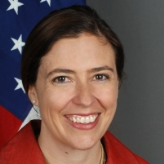
The U.S. Ambassador to Botswana, a lightly-populated nation in Southern Africa which is the world’s leading producer of diamonds and suffers the world’s second highest HIV/AIDS infection rate, is a relatively young foreign policy expert who has specialized in African affairs for more than a decade and was the first Senate staffer to brief then Senator Barack Obama on African issues. Michelle D. Gavin was confirmed by the Senate on April 14, 2011, and arrived at the embassy in Gaborone, Botswana, in June 2011.
Comments