Bookmark and Share
Overview:
The Radiation Exposure Compensation Program (RECP) provides financial restitution to individuals who became seriously ill as a result of nuclear testing and uranium mining during the Cold War. RECP is managed by the Department of Justice’s Civil Division, Torts Branch, which draws money from a special trust fund to make payments to eligible claimants. Compensation ranges from $50,000 to $100,000 depending on which category an individual falls under. As of May 8, 2008, the RECP had approved 19,420 claims and rejected 8,071. Most of the successful claimants have been Downwinders (12,063) and Uranium Miners (4,819). The rest have been Onsite Participants, Uranium Millers and Ore Transporters. Onsite Participants have had the hardest time winning claims, with an approval rate of only 44.7% compared to more than 70% for the other categories.
more
History:
From the early 1940s until the 1960s, the federal government’s nuclear weapons complex demanded certain dangerous activities that caused thousands of citizens to become exposed to radiation. In order to develop new nuclear weapons for the US arsenal, the Atomic Energy Commission conducted a series of aboveground nuclear weapons tests in southern Nevada (the Nevada Test Site). Energy officials also managed underground uranium-mining operations and related activities to produce fuel for nuclear warheads.
 
Radiation exposure from nuclear testing and uranium mining was believed to have caused certain serious diseases, including various types of cancer. As the Cold War came to an end in the late 1980s, lawmakers began examining the legacy of the nuclear weapons program. To address the needs of those who contracted cancer while living downwind from the Nevada Test Site or while working at uranium mines, Congress adopted the Radiation Exposure Compensation Act (RECA) in October 1990.
 
RECA provided that the US Attorney General be responsible for processing and
adjudicating claims under RECA. The Department of Justice (DOJ) established the
Radiation Exposure Compensation Program (RECP), which is administered by its
Civil Division’s Torts Branch. RECP began processing claims in April 1992. DOJ officials set up a trust fund from which compensation was issued to claimants.
 
Throughout the 1990s, many Native American widows were denied compensation because they were unable to establish a legal connection to their deceased counterparts. In response to the issue, DOJ officials revised RECP regulations in 1999 to assist Native American claimants.
 
The following year, Congress adopted a series of amendments to the RECA. The Radiation Exposure Compensation Act Amendments of 2000 added two new categories of workers eligible for federal compensation: uranium mill workers and ore transporters. The amendments also provided additional compensable illnesses, lowered the radiation exposure threshold for uranium miners, included above-ground miners within the definition of “uranium miner,” modified medical documentation requirements and removed certain lifestyle restrictions. Additional geographic areas to the “downwinder” claimant category were put into law.
 
Since April 1992, RECP has authorized payments totaling $1.3 billion for 19,402 claims, according to the program’s claims to date (PDF) statistics. Almost half of the $1.3 billion was paid to claimants who lived downwind of the Nevada Test Site during nuclear weapons testing. The 19,420 claims represented about two-thirds of the 28,176 claims filed since the beginning of the program. The remaining one-third of the claims were either still pending or were denied because RECA’s eligibility criteria were not satisfied.


Nevada Test Site Historical Foundation

more
What it Does:
Administered by the Department of Justice’s Civil Division, Torts Branch, the Radiation Exposure Compensation Program (RECP) provides financial restitution to those who became seriously ill as a result of nuclear testing and uranium mining. Using a special trust fund, RECP disburses fixed payments to eligible claimants in the following amounts:
  • $50,000 to individuals residing or working “downwind” of the Nevada Test Site
  • $75,000 for workers participating in above-ground nuclear weapons tests
  • $100,000 for uranium mining and mill workers and ore transporters
 
Uranium Miners and Mill Workers
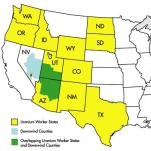
A payment of $100,000 is available to individuals who were employed in aboveground or underground uranium mines or uranium mills located in Colorado, New Mexico, Arizona, Wyoming, South Dakota, Washington, Utah, Idaho, North Dakota, Oregon and Texas at any time from January 1, 1942, to December 31, 1971. Miners must have been exposed to 40 or more working level months of radiation while employed in a uranium mine or worked for at least one year in a uranium mine during the relevant time period. Mill workers must have worked in a uranium mill for at least one year. Compensable diseases for miners and mill workers include primary lung cancer and certain nonmalignant respiratory diseases. Mill workers suffering from renal cancer and other chronic renal disease including nephritis and kidney tubal tissue injury may also be eligible.
 
Ore Transporters
Like miners and mill workers, truckers who transported uranium ore may be eligible for a payment of $100,000. Claimants must have been employed for at least one year in the transport of uranium ore or vanadium-uranium ore from mines or mills located in Colorado, New Mexico, Arizona, Wyoming, South Dakota, Washington, Utah, Idaho, North Dakota, Oregon and Texas from January 1, 1942, until December 31, 1971. Compensable diseases include primary lung cancer, certain nonmalignant respiratory diseases, renal cancer and other chronic renal disease including nephritis and kidney tubal tissue injury.
 
Downwinders
A payment of $50,000 is available to individuals who were physically present in one of the affected areas downwind of the Nevada Test Site during a period of atmospheric nuclear testing. Claimants must have lived or worked for a period of at least two years between January 21, 1951, and October 31, 1958, or from June 30, 1962, to July 31, 1962 in one of the following areas: the Utah counties of Beaver, Garfield, Iron, Kane, Millard, Piute, San Juan, Sevier, Washington and Wayne; the Nevada counties of Eureka, Lander, Lincoln, Nye, White Pine and that portion of Clark County that consists of townships 13 through 16 at ranges 63 through 71; or the Arizona counties of Apache, Coconino, Gila, Navajo, Yavapai and that part of Arizona that is north of the Grand Canyon. Diseases covered are leukemia (other than chronic lymphocytic leukemia), multiple myeloma, lymphomas (other than Hodgkin's disease), primary cancer of the thyroid or any of the following types of cancer: male or female breast, esophagus, stomach, pharynx, small intestine, pancreas, bile ducts, gall bladder, salivary gland, urinary bladder, brain, colon, ovary, liver (except if cirrhosis or hepatitis B is indicated) or lung.
 
Onsite Participants

Those who participated onsite in a test involving the atmospheric detonation of a nuclear device may be eligible for a payment of $75,000. A claimant must have been present above or within the official boundaries of the Nevada, Pacific, Trinity or South Atlantic Test Sites at any time during a period of atmospheric nuclear testing and must have participated during that time in the atmospheric detonation of a nuclear device. Diseases covered are leukemia (other than chronic lymphocytic leukemia), lung cancer, multiple myeloma, lymphomas (other than Hodgkin's disease), primary cancer of the thyroid, or any of the following types of cancer: male or female breast, esophagus, stomach, pharynx, small intestine, pancreas, bile ducts, gall bladder, salivary gland, urinary bladder, brain, colon, ovary, liver (except if cirrhosis or hepatitis B is indicated) or lung.


more
Where Does the Money Go:
Eligible claimants make up the key constituency of the RECP. These individuals consist of people who lived downwind from the Nevada Test Site, uranium mine and mill workers and ore transporters.


FY 2009 Performance Budget

more
Controversies:

America’s Radiation Victims: The Secret Files (by Clifford T. Honicker, New York Times)

The Hanford Downwinders Litigation Information Resourse (Downwinders)


more
Suggested Reforms:

RECP Lacking Scientific Criteria

In 2005, the National Academy of Sciences released a report stating that the radiation compensation program was not utilizing the latest science to determine eligibility of claimants. The study, conducted by the National Research Council, pointed out that only “downwinders” who lived in certain counties of Arizona, Nevada and Utah at the times of nuclear tests were eligible for compensation under RECA.
 
But NRC experts concluded that residents in other counties and states, even some far from the Nevada Test Site, may have been exposed to higher amounts of radiation than those in the currently eligible areas. Other factors such as age at the time of exposure, consumption of contaminated milk or food and age when a disease is diagnosed should also be considered when determining whether someone’s illness was likely caused by nuclear test radiation.
 
“To be equitable, any compensation program needs to be based on scientific criteria and similar cases must be treated alike,” said R. Julian Preston, director of the Environmental Carcinogenesis Division at the US Environmental Protection Agency, who worked on the study. “The current geographic limitations are not based on the latest science.”
 
NRC officials added that this change in eligibility criteria was not likely to significantly increase the number of claimants to the program. But neither Congress nor DOJ officials running RECP decided to endorse the new criteria.
 

Hanford Downwinders

more
See all 113 comments

Comments

ALBERT FROWISS 1 month ago
Wesley Hall, your post is devoid of any info. i do not know how anyone can help you as you had not stated an illness,like type of cancer, or where you worked and when, and of course, how to contact you. albert b. frowiss, sr. my address and contact info is other posts.
ALBERT FROWISS 1 month ago
EVALYN KNOX, not sure why you are posting here on this site. I'm handling your claim via your daughter for your late husband, a Sandia National Labs employee with cancer, and you were paid your award this month, approved final decision in mid March. Perhaps your post was prior to appointing me as your advocate. Anyone else needing help, please contact me directly, as I do not watch this blog site regularly. i'm at 858.756.1494 or box 909, rancho santa fe ca 92067, or frowiss @ frowiss.org email. Albert B. Frowiss, Sr.
ALBERT FROWISS 1 month ago
Marylynn Hook (Bestamente), help is on the way tonight. Sorry, but this is not my web site, so I don't visit it often, but I've helped many people who have posted on this site. I do EEOICPA claims, not RECA claims. EEOICPA pays the claimants much more than RECA but EEOICPA does not apply for military personnel. I've communicated with your sister three years ago and I think tonight we have finally hooked up and we'll get your claim done. Your father is on my 12,000 name HOlmes & Narver employee list for Pacific Proving Grounds from 1950 through 1962, and we'll get the siblings $150,000 divided equally among them. For anyone seeking cancer claim help who was working as a civilian at any atomic weapons facility, production, materials, development, test, they should contact Albert B Frowiss at Box 909, Rancho Santa Fe, CA 92067, or phone 858.756.1494 or email to FROWISS @ FROWISS.ORG I am not a lawyer. I am a professional advocate specializing in this administrative adjudication process and my fee is miniscule at 2 percent only if you get paid, nothing if you do not. I have 1,200 happy clients and have enabled $250 million thus far in payouts since 2008.
Lori Ede 1 month ago
My Dad was in fallon Nevada at the Naval base in 1957 he at that time told his sister he had signed a paper to be exposed to testing being a young man then he did not know what he was signing up for at the age of 43 he died of hairy cell leukemia My mother applied for thie compensation but they told her she didnt have the proof he was there even though in his military records it does show him having been there
Marylynn Hook (Bestamente) 3 months ago
My Father is William Bestamente, He was an employee of Homels and Narver worked on Johnston Island,Kawajalein "down under", He lived on the Island of Ebeye with my mother along with us his children. He passed away in 2010 from colon cancer,COPD,several other health issues. My father suffered alot of health issue throughout his life It never crossed our minds that early years working "down under" would cut short his life. I have medical records and I would like for someone to contact me on how i can find out if my father employment qualifies me as his beneficiary. As i have mentioned my mother was a victim of the "fallout" she had a claim with another group of Nuclear claims Tribunal that did settle in court she lived to only receive partial of her settelment in the amount of $5000.00 she died and left me as beneficiary to receive but i have not receive anything yet. It is very frustrating both of my parents are innocent victims of this tragedy. In all of this I have to live with this hanging over my head " will I die soon too?" I was born there in raised until I was 4yrs. I want answer or any sort of resources on how I can receive benefits that rightfully belongs to me or for my children should i die before that takes place. My parents didn't suffer for nothing they sacrificed their life to see their children to have a better life. I'm scared for my future but i want to be aware of information that will help my children should anything happen to me. Please help me find answers and what my parents would've wanted for their children and grandchildren. my address is P.O Box 503 Kapaau,HI 96755 Thank you for your time and understanding " A very frustrated daughter" In memory of: William "Busta" Bestamente, BIG Island of Hawaii
TERRY RS 3 months ago
Aloha, I was a victim of radiation exposure at Johnston Island PPG, GROUND ZERO. Got cancer of the bladder/prostrate, both removed. Still waiting for my country to "GET MY BACK". I was denied because I worked for the wrong department, DOD. I covered all medical. Sadly EEOICPA still does not cover those excluded. We will die waiting.
Debra 4 months ago
My mom worked on the site, she was pregnant while working there. My sister that she was pregnant with, was born with mental retardation, blindness and only lived until she was 9. My mom is sick to this day as is my dad who was living there with my mom. Where do we start?
TERRYRS 6 months ago
Aloha, I am still here at 75 and still waiting for EEOICPA or RECA to provide medical assistance for us victims. Don't hold your breath and don't believe that " I GOT YOUR BACK " rhetoric, it just isn't true. I was a 1962 Johnston Island PPG, "GROUND ZERO" victim. Aloha and still waiting.
Evalyn Knox 7 months ago
I just received a lengthy letter from the Dept. of Labor requesting more information regarding the claim for Yale Knox. I'm sure you received the same letter. Would please email me and explain exactly what additional information they want? Thank you. Evalyn Knox
TERRY RS 8 months ago
Aloha, I was a victim of the 1961 nuclear tests at Johnston Island PPG. I worked for a DOD contractor. DOL, EEOICPA cannot help you unless you were an employee of DOE. DOJ, RECA has a program for those others. For many years now legislation has been submitted to amend EEOICPA to be inclusive of all, don't hold your breath as each year the amendment dies in committee. 1 percent chance of passing.

Leave a Comment

captcha

Founded: 1992
Annual Budget: $40 million
Employees:
Radiation Exposure Compensation Program
Fischer, Gerard
Previous Assistant Director
As the assistant director of the Department of Justice’s Civil Division, Torts Branch, Gerard W. Fischer oversaw the management of the Radiation Exposure Compensation Program. He did so for more than ten years.
more