Bookmark and Share
News  
Overview  
The Radiation Exposure Compensation Program (RECP) provides financial restitution to individuals who became seriously ill as a result of nuclear testing and uranium mining during the Cold War. RECP is managed by the Department of Justice’s Civil Division, Torts Branch, which draws money from a special trust fund to make payments to eligible claimants. Compensation ranges from $50,000 to $100,000 depending on which category an individual falls under. As of May 8, 2008, the RECP had approved 19,420 claims and rejected 8,071. Most of the successful claimants have been Downwinders (12,063) and Uranium Miners (4,819). The rest have been Onsite Participants, Uranium Millers and Ore Transporters. Onsite Participants have had the hardest time winning claims, with an approval rate of only 44.7% compared to more than 70% for the other categories.
History  
From the early 1940s until the 1960s, the federal government’s nuclear weapons complex demanded certain dangerous activities that caused thousands of citizens to become exposed to radiation. In order to develop new nuclear weapons for the US arsenal, the Atomic Energy Commission conducted a series of aboveground nuclear weapons tests in southern Nevada (the Nevada Test Site). Energy officials also managed underground uranium-mining operations and related activities to produce fuel for nuclear warheads.
 
Radiation exposure from nuclear testing and uranium mining was believed to have caused certain serious diseases, including various types of cancer. As the Cold War came to an end in the late 1980s, lawmakers began examining the legacy of the nuclear weapons program. To address the needs of those who contracted cancer while living downwind from the Nevada Test Site or while working at uranium mines, Congress adopted the Radiation Exposure Compensation Act (RECA) in October 1990.
 
RECA provided that the US Attorney General be responsible for processing and
adjudicating claims under RECA. The Department of Justice (DOJ) established the
Radiation Exposure Compensation Program (RECP), which is administered by its
Civil Division’s Torts Branch. RECP began processing claims in April 1992. DOJ officials set up a trust fund from which compensation was issued to claimants.
 
Throughout the 1990s, many Native American widows were denied compensation because they were unable to establish a legal connection to their deceased counterparts. In response to the issue, DOJ officials revised RECP regulations in 1999 to assist Native American claimants.
 
The following year, Congress adopted a series of amendments to the RECA. The Radiation Exposure Compensation Act Amendments of 2000 added two new categories of workers eligible for federal compensation: uranium mill workers and ore transporters. The amendments also provided additional compensable illnesses, lowered the radiation exposure threshold for uranium miners, included above-ground miners within the definition of “uranium miner,” modified medical documentation requirements and removed certain lifestyle restrictions. Additional geographic areas to the “downwinder” claimant category were put into law.
 
Since April 1992, RECP has authorized payments totaling $1.3 billion for 19,402 claims, according to the program’s claims to date (PDF) statistics. Almost half of the $1.3 billion was paid to claimants who lived downwind of the Nevada Test Site during nuclear weapons testing. The 19,420 claims represented about two-thirds of the 28,176 claims filed since the beginning of the program. The remaining one-third of the claims were either still pending or were denied because RECA’s eligibility criteria were not satisfied.


Nevada Test Site Historical Foundation

What it Does  
Administered by the Department of Justice’s Civil Division, Torts Branch, the Radiation Exposure Compensation Program (RECP) provides financial restitution to those who became seriously ill as a result of nuclear testing and uranium mining. Using a special trust fund, RECP disburses fixed payments to eligible claimants in the following amounts:
  • $50,000 to individuals residing or working “downwind” of the Nevada Test Site
  • $75,000 for workers participating in above-ground nuclear weapons tests
  • $100,000 for uranium mining and mill workers and ore transporters
 
Uranium Miners and Mill Workers
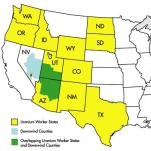
A payment of $100,000 is available to individuals who were employed in aboveground or underground uranium mines or uranium mills located in Colorado, New Mexico, Arizona, Wyoming, South Dakota, Washington, Utah, Idaho, North Dakota, Oregon and Texas at any time from January 1, 1942, to December 31, 1971. Miners must have been exposed to 40 or more working level months of radiation while employed in a uranium mine or worked for at least one year in a uranium mine during the relevant time period. Mill workers must have worked in a uranium mill for at least one year. Compensable diseases for miners and mill workers include primary lung cancer and certain nonmalignant respiratory diseases. Mill workers suffering from renal cancer and other chronic renal disease including nephritis and kidney tubal tissue injury may also be eligible.
 
Ore Transporters
Like miners and mill workers, truckers who transported uranium ore may be eligible for a payment of $100,000. Claimants must have been employed for at least one year in the transport of uranium ore or vanadium-uranium ore from mines or mills located in Colorado, New Mexico, Arizona, Wyoming, South Dakota, Washington, Utah, Idaho, North Dakota, Oregon and Texas from January 1, 1942, until December 31, 1971. Compensable diseases include primary lung cancer, certain nonmalignant respiratory diseases, renal cancer and other chronic renal disease including nephritis and kidney tubal tissue injury.
 
Downwinders
A payment of $50,000 is available to individuals who were physically present in one of the affected areas downwind of the Nevada Test Site during a period of atmospheric nuclear testing. Claimants must have lived or worked for a period of at least two years between January 21, 1951, and October 31, 1958, or from June 30, 1962, to July 31, 1962 in one of the following areas: the Utah counties of Beaver, Garfield, Iron, Kane, Millard, Piute, San Juan, Sevier, Washington and Wayne; the Nevada counties of Eureka, Lander, Lincoln, Nye, White Pine and that portion of Clark County that consists of townships 13 through 16 at ranges 63 through 71; or the Arizona counties of Apache, Coconino, Gila, Navajo, Yavapai and that part of Arizona that is north of the Grand Canyon. Diseases covered are leukemia (other than chronic lymphocytic leukemia), multiple myeloma, lymphomas (other than Hodgkin's disease), primary cancer of the thyroid or any of the following types of cancer: male or female breast, esophagus, stomach, pharynx, small intestine, pancreas, bile ducts, gall bladder, salivary gland, urinary bladder, brain, colon, ovary, liver (except if cirrhosis or hepatitis B is indicated) or lung.
 
Onsite Participants

Those who participated onsite in a test involving the atmospheric detonation of a nuclear device may be eligible for a payment of $75,000. A claimant must have been present above or within the official boundaries of the Nevada, Pacific, Trinity or South Atlantic Test Sites at any time during a period of atmospheric nuclear testing and must have participated during that time in the atmospheric detonation of a nuclear device. Diseases covered are leukemia (other than chronic lymphocytic leukemia), lung cancer, multiple myeloma, lymphomas (other than Hodgkin's disease), primary cancer of the thyroid, or any of the following types of cancer: male or female breast, esophagus, stomach, pharynx, small intestine, pancreas, bile ducts, gall bladder, salivary gland, urinary bladder, brain, colon, ovary, liver (except if cirrhosis or hepatitis B is indicated) or lung.


Where Does the Money Go  
Eligible claimants make up the key constituency of the RECP. These individuals consist of people who lived downwind from the Nevada Test Site, uranium mine and mill workers and ore transporters.


FY 2009 Performance Budget

Controversies  

America’s Radiation Victims: The Secret Files (by Clifford T. Honicker, New York Times)

The Hanford Downwinders Litigation Information Resourse (Downwinders)


Debate  
Suggested Reforms  

RECP Lacking Scientific Criteria

In 2005, the National Academy of Sciences released a report stating that the radiation compensation program was not utilizing the latest science to determine eligibility of claimants. The study, conducted by the National Research Council, pointed out that only “downwinders” who lived in certain counties of Arizona, Nevada and Utah at the times of nuclear tests were eligible for compensation under RECA.
 
But NRC experts concluded that residents in other counties and states, even some far from the Nevada Test Site, may have been exposed to higher amounts of radiation than those in the currently eligible areas. Other factors such as age at the time of exposure, consumption of contaminated milk or food and age when a disease is diagnosed should also be considered when determining whether someone’s illness was likely caused by nuclear test radiation.
 
“To be equitable, any compensation program needs to be based on scientific criteria and similar cases must be treated alike,” said R. Julian Preston, director of the Environmental Carcinogenesis Division at the US Environmental Protection Agency, who worked on the study. “The current geographic limitations are not based on the latest science.”
 
NRC officials added that this change in eligibility criteria was not likely to significantly increase the number of claimants to the program. But neither Congress nor DOJ officials running RECP decided to endorse the new criteria.
 

Hanford Downwinders

Congressional Oversight  
Former Directors  

Comments  
Carl Portwood - 6/28/2010 7:06:00 PM              
Terry S. Could you send a note to my email address and give your address. I was also on Johnston and wanted to talk to you about a few things regarding the assignment. I was in the Air Force, with Joint Task Force 8. Carl Portwood carlhport@yahoo.com

terryrs - 6/28/2010 1:31:46 PM              
I was a participant of the Johnston Island nuclear tests working for the Navy PMRF remote radar tracking station. I contracted both bladder and prostrate cancers, both of which were removed and I now wear a ostomy pouch which serves as my bladder. I did receive a lump sum $75,000 dollar award from the DOJ, RECA compensation program. I served there in 1962/63. Although I was awarded compensation I felt those that did not work for the DOE were denied in that the DOL, EEOICPA awarded their participants $150.000 up to 400,000. I questioned why there was a disparity soley because you worked for the DOE. I have been writing my congressional reps and president concerning this, don't hold your breath as you will probably never get an answer. The DAV organization so expressed how they have been forgotten by our leaders. Senator Inouye expressed his delight in compensating non-Americans for their war participation but he just can't seem to understand that there are Americans that also gave and receive nothing. I have wrote near 100 letters to Pres. Obama and my reps but they just ignore you. For your info, if you were not a DOE participant do not try to receive compensation through the DOL, you must go to the DOJ, RECA program. Aloha to you all that participated and suffered a consequence of being loyal to your country.

Carl Portwood - 5/17/2010 12:41:37 PM              
Terry, Send me an email about your experience with DOJ and RECP. I have just submitted a claim and have a few questions that I beleive you could answer. I am retired Air Force (DOD) and qualify because I contracted one of the compensable cancers but unsure of the issue concerning inclusive dates.

Nominations  
SHEILA FREITAS - 1/15/2010 5:28:09 PM         
MY UNCLE WORKED ON CHRISTMAS ISLAND DURING THE PERIODS NOTED. HOW DO I FIND OUT IF HIS SURVIVING CHILDREN QUALIFY FOR ANYTHING? HIS NAME IS VICTOR K. OHUMUKINI FROM HAWAII.

albert b. frowiss - 1/1/2010 8:20:24 AM         
The EEOICPA law covers former AEC/DOE employees or their contractor employees. In the case of Eniwetok, Bikini, Chistmas or Johnston Islands in the period up through the end of 1962, that means nearly everyone who worked for Holmes & Narver was covered. H&N was the AEC/DOE contractor who hired all the civilian workers. As long as you fit that description, and were there at least 83 calendar days in that time frame, on land or aboard ship, and have had a medical diagnosis of one of the 22 specified cancers, you qualify for compensation of $150,000 or more and should contact me as I've done approximately 400 of these claims successfully. Albert B. Frowiss, P.O. Box 909, Rancho Santa Fe, CA 92067, 858.756.1494, frowiss@frowiss.org is my email. If the worker is deceased, the same applies to his surviving spouse, and more, and if she is deceased, all the children can apply, including stepchildren. Unfortunately, only the RECP law applies to DOD personnel, military or civilian. Johnston Island was owned by the DOD and had other projects, non nuclear (non AEC?DOE), thus the employees who were on those projects aren't covered by EEOICPA. The RECP is quite defective in many regards, aside from the amount of compensation. For example, for "on site participants" it fails to cover renal cancer (kidney), yet renal cancer is radiogenic. Never mind that it is almost impossible to get anyone to answer the phones or emails at DOJ Torts Div.

Leave a Comment  
Name:
Email:
Message:
Enter the code:
Nominate Official  
Name:
Email:
Message:
Enter the code:
Table of Contents

Founded: 1992
Annual Budget: $40 million
Employees: 

Radiation Exposure Compensation Program
Fischer, Gerard
Assistant Director
As the assistant director of the Department of Justice’s Civil Division, Torts Branch, Gerard W. Fischer oversees the management of the Radiation Exposure Compensation Program. He has done so for more than ten years.


wkhrm5551m4k0m55da0mvu55