



Located in Central Asia, Tajikistan was originally settled in 600 BC, and was subsequently part of the Persian, Greek and Kushan empires before becoming part of the Samanid Empire in 875 AD. Under the Samanids, Tajikistan revived the Persian language, and helped to preserve Persian culture in Central Asia. Russia colonized Tajikistan in the 19th century as it expanded its empire. Tajikistan was part of Uzbekistan in 1924, but then became an “independent” Soviet socialist republic in 1929. Tajikistan remained under Russian control until 1991, when the Soviet Union collapsed. After a bloody civil war in the 1990s, Tajikistan has tried to rebuild its economy and political stability. During the winter of 2007-2008, a severe energy crisis added further stress to a population already in poverty. The United States has sought to develop stronger relations with Tajikistan, as part of its counter-terrorism and counter-narcotics strategies in the region. Tajikistan lies along a major drug trafficking route, which the Taliban uses to export opium. American support for the Tajikistan government has come despite its terrible human rights record, one of the worst in Central Asia.
Lay of the Land: Tajikistan forms a bridge between Eastern Europe and Asia. It is located between Afghanistan and Pakistan to the south, China to the east, and Kyrgyzstan and Uzbekistan to the West. Mountains dominate much of the country’s terrain.
During Tajikistan’s early history, it was part of the Persian, Greek and Kushan Empires before becoming part of the Samanid Empire (875-999 AD).
Relations between the United States and Tajikistan began on December 25, 1991, the day the USSR dissolved. The US opened a temporary embassy in a hotel in the capital, Dushanbe, in March 1992. That outpost was evacuated in October 1992, at the height of the civil war, and was not reopened until March 1993.
Current relations between the United States and Tajikistan are cooperative. The United States has helped Tajikistan with its economic and political development as it recovers from its civil war of the 1990s. To aid these efforts, the US has provided humanitarian aid as well as political reconciliation devoted to the promotion of democracy and maintenance of stability in the region.
In 2010, US imports from Tajikistan totaled $1.51 million, a decrease of about $7 million from 2009, while US exports to Tajikistan amounted to $56.8 million, an increase of about $15.7 million from 2009.
Flourishing Drug Trade Assists Taliban
According to the State Department, Tajikistan has, “restricted right of citizens to change their government; torture and abuse of detainees and other persons by security forces; impunity for security forces; denial of right to fair trial; harsh and life-threatening prison conditions; prohibition of international monitor access to prisons; restrictions on freedoms of speech, press, association, and religion; corruption, which hampered democratic and social reform; violence and discrimination against women; arbitrary arrest; and trafficking in persons.”
Tracey Jacobson served as the United States Ambassador to Tajikistan from August 29, 2006, until August 2009.
Appointment: Aug 11, 1992
Presentation of Credentials: Oct 19, 1992
Termination of Mission: Embassy Dushanbe was closed Oct 25, 1992, and all US personnel were withdrawn. Escudero reopened the Embassy Mar 11, 1993, and left post Jun 1, 1995
Appointment: Jun 27, 1995
Presentation of Credentials: Jul 31, 1995
Termination of Mission: Left post Aug 21, 1998
Appointment: Oct 22, 1998
Presentation of Credentials: Nov 11, 1998
Termination of Mission: Left post Jul 13, 2001
Appointment: Oct 1, 2001
Presentation of Credentials: Oct 26, 2001
Termination of Mission: Left post Oct 9, 2003
Appointment: Oct 6, 2003
Presentation of Credentials: Nov 24, 2003
Termination of Mission: Left post, Aug 3, 2006
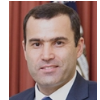 Farhod, Salim
Farhod Salim was took over as Tajikistan’s ambassador to the United States on May 15, 2014. It’s the first ambassadorial post for the long-time member of his country’s Foreign Service.
Salim was born April 30, 1975, in Kurgan-Tyube (now Qurghonteppa), Tajikistan. His father, Abdulmajid Dostiyev, is a former member of the Tajikistan parliament and was more recently an ambassador to Russia. Salim earned a law degree from Tajik State National University and studied computer science at the College of Staten Island in New York.
His first posting as a member of the Foreign Service came in 1998 as an attaché at the United Nations. He returned home in 1999 as second secretary, and subsequently as first secretary, in the Department of International Organizations in the Tajik Ministry of Foreign Affairs. Salim was assigned in 2003 as first secretary in Tajikistan’s Belgian embassy and served as chargé d’affaires for several months at the end of his assignment there.
In 2007, Salim returned to Tajikistan as counselor in the Department of International Organizations. The following year he was made first secretary in the Department of European and American Countries, and shortly thereafter chief of International and Regional Organizations. In 2009, Salim was named to lead the Department of European and American Countries.
He came to Washington in 2011 as deputy chief of mission at the Tajik Embassy, serving as chargé d’affaires for a time in 2012, and has been there since.
One of his priorities since being named ambassador has been to have Tajikistan removed from the list of countries covered by the 1975 Jackson-Vanik Amendment, which puts trade restrictions on countries in the former Soviet bloc for having restrictive immigration policies.
Salim is married and has three children.
-Steve Straehley
To Learn More:
- Table of Contents
- News
- Overview
- Basic Information
- History
- Newspapers
- History of U.S. Relations with Tajikistan
- Current U.S. Relations with Tajikistan
- Where Does the Money Flow
- Controversies
- Human Rights
- Debate
- Past Ambassadors
- Ambassador to the U.S.
- Embassy Web Site in the U.S.
- Comments
- Leave a comment


U.S. Ambassador to Tajikistan
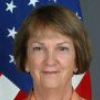
One of the most oppressive post-Soviet dictatorships, the central Asian nation of Tajikistan has won the friendship of the U.S. government through its cooperation with Washington’s wars in the region. President Barack Obama on April 16 nominated career diplomat Susan Marsh Elliott to be the next ambassador in Dushanbe. If confirmed by the Senate, Elliott will be the second female U.S. Ambassador to Tajikistan after her predecessor’s predecessor, Tracey Ann Jacobson, who is currently Ambassador to Kosovo.
Born circa 1952, Elliott earned a B.S. at Skidmore College in Sarasota Springs, New York, in 1974, an M.S. at Russell Sage College in Troy, New York, and a doctorate in Nursing at Indiana University in 1987, with a thesis entitled “Variables associated with organizational effectiveness of schools of nursing.” She taught Nursing at Ball State University and the University of Virginia.
Elliott joined the Foreign Service in 1990 after working as a nurse at the U.S. Embassy in Tegucigalpa, Honduras. Her early career postings included service in Lima, Peru, from 1990 to 1992, and Moscow, Russia, from 1992 to 1994. She served as a desk officer from 1994 to 1995 in the Office of the Coordinator for Regional Conflicts in the New Independent States, where she reported on conflicts in the Caucasus (Nagorno-Karabakh and Georgia) and Central Asia, including Tajikistan. Elliott also worked as a member of the Executive Secretariat Staff from 1995 to 1997. Elliott then served four years at the embassy in Athens, Greece, as deputy economic counselor from 1999 to 2001 and as visa section chief from 2001 to 2003.
From 2003 to 2005, Elliott served as office director of the Executive Secretariat Staff, and from 2005 to 2007 as a deputy executive secretary on the staff of Secretary of State Condoleezza Rice, where her responsibilities included Europe, and South and Central Asia. Elliott was the principal officer at the U.S. consulate general in Belfast, Northern Ireland, from 2007 to 2009, and served in Moscow as minister counselor for Political Affairs from 2009 to 2010. Since September 2010, Elliot has been deputy assistant secretary of state for the Bureau of South and Central Asian Affairs.
Elliott speaks Russian, Greek, and Spanish. She is married to Matthias Mitman, who is also a Foreign Service officer. They have two adult sons.
-Matt Bewig
more
Comments