



Occupying a 700-mile peninsula in the Mediterranean, Italy is shaped like a boot, with Sicily at the toe. The country shares boundaries with France, Switzerland, Austria and Yugoslavia. Although originally settled by the Greeks, Romans, and Etruscans, Italy was eventually united after the Renaissance in 1861. From 1870 to 1922, Italy existed as a constitutional monarchy and sided with the Allies in World War I. However, World War II brought fascism and an alliance with Nazi Germany under Benito Mussolini. After the Axis Powers were defeated, the Italian monarchy was ended, and the country’s borders adjusted as part of the peace treaty. Since the 1950s, Italy has made significant strides in joining the European community of nations, joining NATO in 1950 and allying itself with the United States. Although the Italian government has suffered from violence and corruption, not to mention influence from organized crime, the country instituted reforms during the 1990s, only to fall again into corruption when Prime Minister Silvio Berlusconi was indicted on charges stemming from tax evasion, bribery and antitrust violations in 2004. More than 15 million Americans have family roots in Italy.
Lay of the Land: Italy’s 700-mile-long peninsula juts out of the European heartland into the Mediterranean like a long leg wearing a high-heeled boot, with the island of Sicily at its toe. The south slope of the majestic Alps is Italy’s, forming the western boundary with France, the northern boundary with Switzerland, Austria, and the eastern boundary with Yugoslavia. Italy includes Sicily, Sardinia, and many smaller islands, notably Elba (where Napoleon was exiled), Capri, and Ischia Vatican City (the Papal State in Rome) and San Marino (oldest republic in the world) are independent enclaves within Italy. Scenic beauty is diverse, from the vast, fertile Po Valley, picturesque lakes, and Alps in the north to aridity and expanses of hill country in the south, to green, undulating hills in Umbria and Tuscany, to the rugged landscape of the Apennines running the length of the peninsula and forming a spiny backbone. Italy’s mountainous character (nearly 80%) has bred regionalism, which has long influenced political and economic developments.
The United States enjoys warm relations with Italy. Italy is a leading trade partner with the US, and the two countries are NATO allies. Additionally, the United States and Italy cooperate in regional organizations. In recent years, Italy and the United States have worked together on NATO and UN missions, as well as with assistance to Russia and the New Independent States; Lebanon; the Middle East peace process; multilateral talks; Somalia and Mozambique peacekeeping; and combating drug trafficking, trafficking in women and children, and terrorism. The US and Italy also cooperate on major economic issues, such as the G-8 Summit.
Through October 2008, Italy was the US’s 14th largest trading partner, with total bilateral trade of $44.4 billion ($13.3 billion in exports to Italy and $31.1 billion in imports from Italy). The US’s $17.7 billion deficit with Italy through October 2008 was consistent with the $20.9 billion deficit registered in 2007.
J. Paul Getty Museum Embroiled in Antiquities Controversy
The 2007 State Department human rights report stated that problems involving lengthy pretrial detention, excessively long court proceedings, violence against women, trafficking in persons, and abuse of Roma remained problems.
Included among the more illustrious U.S. ambassadors to Italy are William Waldorf Astor who, five years later (1890), inherited the largest fortune in the United States; Ellsworth Bunker, who later served as ambassador to South Vietnam during most of the Vietnam War (1967-1973); Claire Boothe Luce, playwright, journalist and member of the House of Representatives (1943-1947); and John Volpe, governor of Massachusetts and Secretary of Transportation under Richard Nixon.
 Bisogniero, Claudio
Claudio Bisogniero, who has been posted to the U.S. on two previous occasions, officially took the reins as Italy’s ambassador to the U.S. on February 6, just in time to coordinate the visit to Washington of Italian Prime Minister Mario Monti, who will arrive on February 9. The previous ambassador, Giulio Terzi, was called back to Italy to serve as foreign minister after the forced resignation of the nation’s controversial prime minister, Silvio Berlusconi.
- Table of Contents
- News
- Overview
- Basic Information
- History
- Newspapers
- History of U.S. Relations with Italy
- Current U.S. Relations with Italy
- Where Does the Money Flow
- Controversies
- Human Rights
- Debate
- Past Ambassadors
- Ambassador to the U.S.
- Embassy Web Site in the U.S.
- Comments
- Leave a comment

U.S. Ambassador to Italy

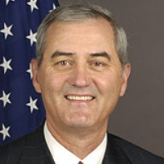
The new ambassador to Italy and the micro-state of San Marino is an Italian-American public interest attorney who owns a villa in Tuscany and has visited Italy “more than 50 times in the last decade.” John R. Phillips, whose nomination was confirmed by the Senate along with several others on August 1, succeeds David Thorne, who had served in Rome since August 2009.
Born in late 1942 and raised 35 miles northeast of Pittsburgh in Leechburg, Pennsylvania (1950 pop.: 4,042), which he has described as “a bustling steel and coal-mining area [with] a lot of jobs. I walked to school and you knew everybody.” His paternal grandfather, Angelo Filippi, emigrated from the Friuli region of Italy to Pennsylvania, where he met his wife Lucy Colussy, also from Friuli. At his Senate hearing, Phillips said he regretted that the family name, Filippi, had been Americanized to Phillips. According to his aunt, Edna Logero, the name changed when her older brother William first went to school and the “teacher said Phillips was more American. My dad was furious over that.” William, who grew up to become Phillips’ father, later owned a Ford dealership in Leechburg.
John Phillips graduated Leechburg High School in 1960, and after a two-year hitch in the military, earned a B.A. in Government and International Studies at Notre Dame University in 1966 and a J.D. at the University of California Law School, known as Boalt Hall, in 1969. Showing early on the sense of humor he has become known for, while at Notre Dame he ran for class president with the slogan, “Phillips 66.”
After law school, Phillips joined the Los Angeles mega-law firm of O’Melveny & Meyers as an associate. He left after two years to co-found one of the first Ford Foundation funded public interest law firms--the Center for Law in the Public Interest in Los Angeles, which focused on environmental, civil rights, corporate fraud and other issues. Phillips served as its co-director for 17 years, from 1971 to 1988. From 1984 to 1986, Phillips played a role in urging Congress to revise the False Claims Act by strengthening provisions that allow whistleblowers to bring lawsuits on behalf of the government against persons or corporations that are defrauding the government. The amendments went into effect in 1986.
In 1988, Phillips founded his own law firm, Phillips & Cohen, based in Washington, DC, to specialize in whistleblower cases. At his Senate confirmation hearing, Phillips testified that his firm had helped recover $55 billion from companies that were defrauding the government. The National Law Journal has included him on several of its “100 most influential lawyers in America” lists. Phillips retired from his firm this year in order to accept the posting to Italy.
From 1988 to 1993, Phillips was an appointed member of the Ninth Circuit Judicial Conference. He was also appointed, in 1997, by President Bill Clinton to the President’s Commission on White House Fellowships, of which President Obama named Phillips chair in 2009.
Phillips is the founder of Taxpayers Against Fraud, a nonprofit that promotes the use of the False Claims Act and its qui tam provisions to fight fraud against the government, and served on its board of directors until 2013.
In 2001, Phillips bought and over eight years restored and redeveloped the ruined remains of an abandoned, 13th century Tuscan farming village named “Borgo Finoccchieto.” It now consists of a luxurious boutique hotel, five buildings on six acres surrounded by farmlands that can accommodate up to 44 guests for weddings, events and retreats. “By living there and getting to know the people, I know it very well,” he said.
A lifelong Democrat, Phillips has donated more than $200,000 to Democratic candidates and organizations over the years, including $106,000 to the Democratic National Committee and $9,600 to Barack Obama’s presidential campaigns.
John Phillips has been married more than 40 years to Linda Douglass, a former ABC correspondent who was a campaign spokeswoman for Barack Obama in 2008, helped organize his first inauguration, and served as director of Communications for the White House Office of Health Reform from 2009 to 2010. They have a daughter, Dr. Katie Byrd, who is an emergency room physician at George Washington University Hospital.
-Matt Bewig
To Learn More:
Leechburg Native Confirmed as U.S. Ambassador to Italy (by Debra Duncan, Pittsburgh Post-Gazette)
Testimony Before the Senate Foreign Relations Committee (pdf)
Ambassador to Italy proud of Leechburg roots, Italian heritage (by Brian C. Rittmeyer, Valley News Dispatch)
John R. Phillips is the New US Ambassador to Italy (by Giulia Madron, i-Italy)
morePrevious U.S. Ambassador to Italy
Comments