



The Office of Navajo and Hopi Indian Relocation (ONHIR) is an independent agency responsible for assisting Hopi and Navajo Indians impacted by the relocation that Congress mandated in 1974 for members of the tribes who were living on each other’s land. Imposed by the Navajo-Hopi Land Settlement Act of 1974, the relocation was intended to be a temporary process to resolve land disputes among the tribes that had been ongoing for decades. But discord between varying involved parties continued to arise, preventing the desired final resolution, and resulting in the cost of the program ballooning, Congress amending the Act, and various politicians attempting to put an end to the ONHIR.
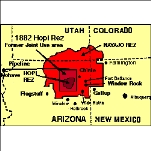
The Office of Navajo and Hopi Indian Relocation (ONHIR), initially known as the Navajo and Hopi Indian Relocation Commission, was created by Congress in 1974, to promote a comprehensive settlement of the land disputes between the Navajo and Hopi Native American tribes, which can be traced back to the establishment of a reservation in 1882 for the Hopis, and a Navajo Reservation in 1934. During that period, when the reservations were developed, covering areas in Arizona, Colorado, New Mexico, and Utah, some members of the Hopi tribe lived within territory allocated for the Navajo tribe, while some members of the Navajo tribe resided within territory set aside for the Hopis. As a result, at times tensions built, and in 1958 Congress passed legislation giving authority to the two tribes to file suits in Federal Court to resolve territorial disagreements. This legislation initiated a longstanding litigation dispute, which ultimately led to Congress passing the Navajo-Hopi Land Settlement Act of 1974. The statute authorized the United States District Court for the District of Arizona to make final judgment in the matter, including partition of the joint area, and established the ONHIR, to facilitate relocating members of the two tribes to the land partitioned to them.
On February 12, 1977, the Partition Order was entered by the Court, with the Commission being required to formulate a report to Congress within two years of that date, with another five years allocated to execute the plan. But various problems soon arose, including some tribe members refusing to leave their homes, a mounting set of new legal disputes, and claims of misuse of the funding for the relocation program. At various junctures, Congress stepped in with amendments that covered a range of subjects, including extending deadlines, adjusting government appropriation amounts, amending provisions on new lands, and changing the name of the agency to its current Office of Navajo and Hopi Indian Relocation. Several local politicians also got involved, with their concerns including the length of time the process was taking, and its growing cost, which led to debate about the value of keeping or ending ONHIR. Various dates have been proposed to close the agency, and transfer its remaining obligations, necessary personnel, and funding to the Department of Interior, but no determinations have yet been finalized, and around 190 appeals surrounding the Act are still pending.
Navajo-Hopi Land Dispute (by Harrison Lapahie, Jr.)
Navajo-Hopi Long Land Dispute (by Paula Giese, Beaded Lizard Web Designs)
The Office of Navajo and Hopi Indian Relocation (ONHIR) is located in Flagstaff, Arizona, with two satellite offices in Sanders and Chambers, Arizona. It has overseen one of the largest relocation efforts in U.S. history, relocating more than 15,000 members of the Navajo and Hopi tribes, a majority of them Navajos. The total cost has exceeded $500 million and is still growing.
Among ONHIR duties: Making eligibility for relocation and benefits determinations, and hearing appeals of those denied eligibility; acquiring land for the tribe members mandated to move; arranging for the construction of their new housing; and meeting the potential burdens to individuals and families imposed by the relocation, providing support to help the relocated tribe members as they aim to avoid or mend economic, social, and cultural harm from the move.
Commission Operations and Relocation Procedures
From the ONHIR Web Site
Budget and Performance Reports
Housing Contractor Requirements
Management Manual (pdf)
According to the ONHIR FY 2013 Appropriation Summary Statement, the agency’s $8,400,000 in funding is estimated to be spent as follows:
Lands and structures $2,920,000
Personnel compensation $2,875,000
Personnel benefits: Civilian $719,000
Other services $674,000
Rental payments, communications, utilities, miscellaneous $583,000
Grants $329,000
Travel and transportation $117,000
Equipment $75,000
Supplies and materials $74,000
Bonuses $20,000
Printing and reproduction $13,000
Transportation of things $1,000
Total Requirements $8,400,000
Operations being funded during FY 2013 are in support of the ONHIR’s plans to relocate 100 families. There are 151 pending appeals of denied cases.
Expand Federal Office to Assist Reconstruction
A leading Native American official implored Congress more than once to expand funding and oversight for the Office of Navajo and Hopi Indian Relocation (ONHIR), in order to speed up construction on tribal lands.
Raymond Maxx, executive director of the Navajo-Hopi Land Commission Office for the Navajo Nation, testified before lawmakers in 2011 and 2012 urging them to help his people overcome decades of infrastructure problems.
Maxx explained that many homes lack electricity and running water in a region known as the Bennett Freeze area, which also suffers from an insufficient number of schools and a lack of economic development.
To help rectify this situation, Maxx requested Congress to authorize the ONHIR to oversee reconstruction activities, “with the Navajo Nation having the option of assuming control of those activities that affect Navajo people and lands, as well as the option of assuming control of the trust fund proposed above.”
He also asked that the ONHIR budget, which has ranged from $8 million to $9 million, be doubled to $18 million.
Raymond Maxx Testimony March 2012 (House Interior Appropriations Subcommittee)
Raymond Maxx Testimony May 2011 (House Interior Appropriations Subcommittee)
In recent years there has been discussion, and attempted legislation, regarding closing down the ONHIR, as a result of it having taken much longer than Congress intended to carry out the tribal relocations. The cost of the process has also been of concern to various government officials, and others. Alternatively, legislation has been introduced that would grown the ONHIR in order to aid families that have been relocated.
Close Down the ONHIR
In 2005, Republican Arizona Senator John McCain, Chairman of the Senate Committee on Indian Affairs, sponsored a Senate bill that would phase out the ONHIR and transfer its duties to the Department of the Interior. The Hopis supported its aim of basically ending the relocation process, while Roman Bitsuie, the Navajo Executive Director of the Navajo-Hopi Land Commission, criticized the bill on several grounds, including pointing out that the total cost of the ONHIR since its establishment was comparable to the amount the United States government was spending in Iraq in a 36-hour period. He also referred to the fact that a result of the relocation was that many Navajo families that had previously lived self-sustaining lifestyles were now finding it impossible to reestablish themselves in a beneficial manner, and that it was the right thing to do to keep the agency alive to help them further adjust to their new environment.
Navajo-Hopi Land Settlement Hearing Before The Committee On Indian Affairs United States Senate (U.S. Government Printing Office)
Grow the ONHIR
McCain’s bill never came to a final resolution, and the following year Arizona Republican Congressman Rick Renzi sponsored alternative legislation to expand the ONHIR and include additional funding for rehabilitative aid for the parties relocated. But this bill didn’t pass, either. Since then, both men who put forth the bills had the focus of their lives change dramatically. McCain made an unsuccessful run for the Presidency, and Renzi received a 41-count indictment on federal fraud charges, including conspiracy, money laundering, insurance fraud, and extortion, relating to an alleged illegal land deal. Meanwhile, the ONHIR continues operating, and the process of implementing the remaining relocations is ongoing.
McCain’s Relocation Legislation (Black Mesa Indigenous Support)
- Table of Contents
- Overview
- History
- What it Does
- Where Does the Money Go
- Controversies
- Suggested Reforms
- Comments
- Leave a comment

Comments